Released in 1967, The Dirty Dozen earned its reputation as a war-film classic, blending suspense, high-risk action, and a powerhouse cast that included Charles Bronson, Ernest Borgnine, Lee Marvin, Donald Sutherland, and George Kennedy. The film centers on twelve military convicts selected for a near-impossible mission just before D-Day, forcing them to rely on grit and ingenuity to survive. Its gripping premise and memorable performances have helped it endure as a favorite for generations of viewers.
Below are some intriguing and lesser-known facts about The Dirty Dozen that may surprise even longtime fans.
The Filthy Thirteen

We’ll start by looking at the real-life group that inspired The Dirty Dozen‘s source material. Known as the “Filthy Thirteen,” they were part of the 1st Demolition Section, Regimental Headquarters Company, 506th Parachute Infantry Regiment, 101st Airborne Division during World War II.
The group earned their distinctive moniker while stationed in England, due to their habit of bathing no more than once a week. Once in mainland Europe, they were tasked with sabotaging enemy targets behind the lines. Their engagements included D-Day and Operation Market Garden.
Jim Brown retired from the NFL while filming The Dirty Dozen

Jim Brown, celebrated both as a football icon and a Hollywood star, portrayed Robert T. Jefferson in The Dirty Dozen. While he enjoyed the experience on set, the extended filming schedule clashed with his National Football League (NFL) commitments.
Donald Sutherland almost didn’t appear in The Dirty Dozen

It’s tough to picture anyone but Donald Sutherland as Vernon L. Pinkley in The Dirty Dozen—but he nearly wasn’t in the role! Sutherland was actually the second actor cast, stepping in after the original performer bowed out at the last minute, claiming the part wasn’t worthy of his talents.
Judging by the film’s enduring fame, that was probably a decision they came to regret!
One of the largest sets ever built

The French château featured in The Dirty Dozen may appear grand, but did you know it was one of the largest set pieces ever built? Designed by art director William Hutchinson and a dedicated team of 85 workers, the château stretched 240 feet in length and stood 50 feet tall. To make it more convincing, landscapers added six weeping willows, 450 shrubs, 30 spruce trees, 5,400 square yards of heather, and 400 ferns to create a truly lifelike environment.
The structure was so solidly built that it would have taken an astounding 70 tons of explosives to demolish it. For the dramatic scene where the château is blown up, the crew had to use a lighter, more manageable replica made from plastic and cork.
Serving as an anti-war allegory for Vietnam

Although The Dirty Dozen is a war movie, director Robert Aldrich intended it to serve as an anti-war allegory for the Vietnam War. as was the intention of director Robert Aldrich. This is evident in the film’s anti-military and -authority tones.
Released when the United States was deeply involved in the Vietnam conflict, the film is widely regarded as one of the earliest public critiques of the war, even though it is set during World War II.
Lee Marvin’s alcoholism was a major problem during filming

It’s well known that Lee Marvin struggled with alcohol throughout his life, and his drinking became a serious issue during the filming of The Dirty Dozen. Many believe his struggles were linked to his wartime experiences, as he served with the U.S. Marine Corps in the Pacific Theater during World War II.
In one scene, Marvin’s character, Maj. John Reisman, was supposed to drive an armored truck while Joseph Wladislaw (Charles Bronson) sat in the passenger seat. However, when it was time to film, Marvin was nowhere to be found. Crew members eventually located him at a pub and brought him back to set, where they gave him coffee in an attempt to sober him up.
Upon his arrival, Bronson came up to him and said, “I’m going to f*****g kill you, Lee.”
John Wayne as Maj. John Reisman?

Just like Donald Sutherland, Lee Marvin wasn’t the original choice to play Maj. John Reisman in The Dirty Dozen—another Hollywood legend was first offered the role. Curious who it was? None other than the Duke himself, John Wayne!
Wayne, well-known for his performances in war films like The Longest Day (1962) and The Alamo (1960), ultimately declined the part due to his personal principles. The actor didn’t approve of the character’s affair with an enlisted man’s wife while her husband was serving overseas.
Moreover, Wayne opted out to focus on a project intended to rally public support for the Vietnam War, as American enthusiasm for the conflict had begun to decline at that time.
Several members of the cast served during World War II

As with many military movies released in the post-war era, The Dirty Dozen featured a number of veterans:
- Lee Marvin, US Marine Corps – He saw action as a scout sniper and was injured during the Battle of Saipan.
- Robert Webber, US Marine Corps – He served as a 776-Radio Operator (Low Speed) in Guam and on Okinawa.
- Charles Bronson, US Army Air Forces – He flew 25 combat missions over Japan aboard a Boeing B-29 Superfortress.
- Ernest Borgnine, US Navy – He was dispatched to the Atlantic coast aboard the patrol yacht USS Sylph (PY-12).
- Telly Savalas, US Army – While never deployed overseas, he was stationed out of Camp Pickett, Virginia from 1941-43.
- George Kennedy, US Army – He served under Gen. George Patton and saw action during the Battle of the Bulge.
- Robert Phillips, US Marine Corps – He was a self-defense instructor with the service throughout WWII.
- Clint Walker, Merchant Marine – He quit school and enlisted in the Merchant Marine when he was just 17 years old.
- Robert Ryan, US Marine Corps – He served as a drill instructor at Marine Corps Base Camp Pendelton, California.
- Richard Jaeckel, Merchant Marine – He enlisted close to the end of the war and remained with the service until 1949.
- Ralph Meeker, US Navy – He only served for a few months before being discharged for an injured neck.
Four of the actors reunited over 30 years later

It’s rare for two actors to reunite on a later project—so having four come together again is almost unheard of. But that’s exactly what happened 31 years after The Dirty Dozen hit theaters. Ernest Borgnine, Clint Walker, George Kennedy, and Jim Brown all returned to voice characters in the 1998 movie Small Soldiers, directed by Joe Dante.
The film tells the story of action figures that come to life after being equipped with advanced military microchips. Think Toy Story (1995), but with a darker, more grown-up twist.
From The Dirty Dozen to M*A*S*H

As mentioned earlier, Donald Sutherland portrayed Vernon L. Pinkley in The Dirty Dozen — and that performance played a pivotal role in shaping his career. His standout presence in the film caught the attention of director Robert Altman, who subsequently cast him in the 1970 war satire M*A*S*H.
More from us: Behind-the-Scenes Facts About ‘Crimson Tide’
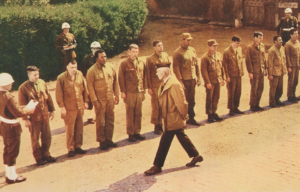
Here’s how the story goes: In The Dirty Dozen, there’s a memorable sequence in which Vernon L. Pinkley impersonates a general to inspect the troops of Col. Everett Dasher Breed, played by Robert Ryan. The scene was initially intended for Clint Walker, but Walker felt uneasy performing it, and the role was reassigned to Donald Sutherland.
Sutherland’s comedic timing and distinctive screen presence in that moment reportedly drew significant attention. According to industry accounts, the performance helped convince director Robert Altman to cast him as Benjamin “Hawkeye” Pierce in M*A*S*H—a role that would become one of the defining performances of his career.
Sutherland’s role as Hawkeye Pierce in M*A*S*H became one of his most iconic performances, helping cement his status as a major figure in 1970s cinema.