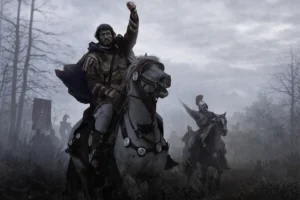
Most history books claim the Roman Empire fell in 476 AD. They are wrong. Less than sixty years after the “fall,” a single man nearly put the pieces back together.
Flavius Belisarius was the primary sword of the Emperor Justinian. While the classic Roman Legions of Caesar relied on massive infantry blocks, Belisarius pioneered a new, high-speed form of warfare. With a tiny elite force of “Bucellarii”—armored horse archers—he defeated Persians, Vandals, and Goths on three different continents.
1. The Nika Riots: Saving the Throne

Belisarius’s most grim victory didn’t happen on a foreign battlefield, but in the heart of Constantinople. In 532 AD, sports fans of the Blue and Green chariot factions united in a massive uprising known as the Nika Riots.
With the city in flames and the Emperor Justinian preparing to flee, it was Belisarius who took charge. He trapped 30,000 rioters inside the Hippodrome and crushed the insurrection. It was a brutal necessity that stabilized the Empire and allowed Justinian to begin his “Reconquest of the West.”
2. The African Blitz: Obliterating the Vandals

In 533 AD, Belisarius landed in North Africa with just 15,000 men to face the Vandals, the Germanic tribe that had famously sacked Rome decades earlier.
At the Battle of Ad Decimum, Belisarius used his cavalry’s mobility to outmaneuver the Vandal king. In a lightning campaign that lasted only a few months, he reclaimed the “breadbasket of Rome”—the rich provinces of North Africa—and returned to Constantinople in a triumph the likes of which hadn’t been seen in centuries.
3. Reclaiming the Eternal City

The ultimate goal was Italy. Belisarius invaded the peninsula in 535 AD, capturing Naples and eventually Rome itself.
Holding Rome, however, was harder than taking it. For a full year, Belisarius and a small garrison of 5,000 men were besieged by a Gothic army numbering over 45,000. Using ingenious engineering—including water mills to grind grain when the Goths cut the aqueducts—and constant psychological warfare, Belisarius broke the siege. He had returned Rome to the Romans.
4. The Temptation of the Crown

Perhaps the most incredible part of Belisarius’s story is his loyalty. When he cornered the Goths at their capital of Ravenna, the Goths were so impressed by his genius that they offered him a deal: they would surrender if Belisarius declared himself the new Emperor of the West.
Belisarius feigned acceptance to gain entry into the city. Once inside, he seized the city for Justinian and refused the crown. Despite his emperor’s constant jealousy and paranoia, Belisarius never once attempted a coup.
5. The “Blind” Legend

The end of Belisarius’s life is shrouded in legend. While historical records suggest he died in favor, popular lore claims that a jealous Justinian eventually had his greatest general blinded and forced him to beg in the streets of Constantinople.
Regardless of his end, his impact was undeniable. He expanded the Byzantine Empire by nearly 50%, proved that the Roman military machine could still dominate the world, and earned his place as the “Last of the Romans.”