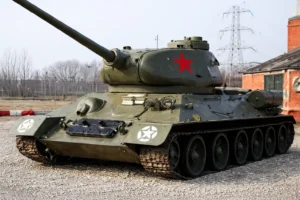
In the summer of 1941, during the opening stages of Operation Barbarossa, German tank crews encountered a battlefield “ghost” that shattered their belief in Panzer superiority: the Soviet T-34.
On paper, the T-34 was a masterpiece of military engineering. Its 76.2mm gun could penetrate a Panzer III at 1,000 meters, while its revolutionary sloped armor deflected almost every standard anti-tank shell the Germans possessed. General Heinz Guderian was so impressed that he suggested copying its core features—sloped armor and wide tracks—which eventually served as the design DNA for the Panzer V Panther.
By late 1941, the Wehrmacht had captured hundreds of T-34s intact—enough to equip test units and send German engineers into a state of panic. Yet, despite having these “super-tanks” in their possession, they only put a few dozen into active service as Beutepanzers (captured tanks). Here is the deep dive into why the German Army sidelined a weapon that theoretically outclassed their own.
1. The “Friendly Fire” Death Trap

The biggest threat to a German-operated T-34 (labeled the Pz.Kpfw. 747(r)) wasn’t the Red Army—it was the Wehrmacht’s own high-strung anti-tank units.
The T-34’s silhouette was so distinct and so synonymous with “the enemy” that German anti-tank crews were trained to fire the moment they saw it. In the chaos of the Eastern Front, where mud, snow, and rain obscured vision, even oversized Balkenkreuz (German crosses) painted on the turrets offered little protection.
2. The Diesel Logistical Fiasco

The German military machine was a “Benzin” (gasoline) culture. From the smallest motorcycle to the heaviest Tiger tank, almost every vehicle in the Wehrmacht ran on Maybach gasoline engines. The T-34, however, utilized the sophisticated V-2 diesel engine.
While diesel was more efficient and less prone to catastrophic fires, the Wehrmacht had an issue resupplying it towards the Eastern Front. They had significant, if limited, diesel capabilities, but their primary, overwhelming need on the Eastern Front was gasoline for their tanks. The issue was not the type of fuel, but the catastrophic inability of their logistics system to deliver adequate fuel supplies of any kind to the front lines during the long, arduous campaign.
3. “Fighting Blind”: The Ergonomic Nightmare

German Panzers were designed around the “Human-Machine Interface.” They featured a 5-man crew with a dedicated commander who sat in a cupola with 360-degree vision. This allowed the commander to lead the tank while the gunner and loader focused on their specific tasks.
The early T-34/76 was a cramped 4-man nightmare.
- The Overloaded Commander: In the T-34, the commander was also the gunner. He had to lead the unit, spot targets, and aim the gun simultaneously.
- Abysmal Optics: The Soviet vision blocks were of poor quality and prone to fogging. German testing at the Kummersdorf proving grounds confirmed that German crews’ hit rates dropped by nearly 50% when switching from a Panzer IV to a T-34. They simply couldn’t see the enemy, and they couldn’t lead the unit while staring through a gun sight.
4. Mechanical Unreliability: The Hidden Cost

While the T-34’s design was superior, its manufacturing quality was often abysmal under wartime pressure. German engineers were shocked to find that early T-34s often had transmissions that required a wooden mallet to shift gears.
More importantly, the air filters were notoriously poor, meaning engines would often fail after just a few hundred kilometers in the dusty Russian summer. The Germans, who prized mechanical precision and long-term reliability, viewed the T-34 as a “disposable” weapon. Without a steady stream of Soviet factory parts, a T-34 was a liability that would break down long before it reached the front lines.
The Legacy: From Inspiration to the Panther
Guderian urged adopting the T-34’s sloped armor and tracks, which influenced the Panther—but Germany built its own refined version with superior optics and crew layout. Instead, they incorporated the T-34’s genius—sloped armor and wide tracks—into a uniquely German package. This resulted in the Panther, which combined Soviet-style protection with German Zeiss optics and 5-man ergonomics.
Ultimately, the T-34 was a foreign body the German system couldn’t digest. It remained more valuable as a blueprint for the future of tank warfare than as a weapon in the hands of the Wehrmacht.