On the International Day to End Racial Discrimination, let’s revisit the story of over one million Black Americans who stormed beaches and flew combat missions — while their own government treated them as second-class citizens.
Every March 21, the world marks the International Day for the Elimination of Racial Discrimination, a date etched in history by the 1960 Sharpeville Massacre, when South African police killed peaceful protesters. But two decades earlier, on American soil and foreign battlefields, a different fight against racial discrimination was already being waged by men in uniform.
“Should I Sacrifice My Life to Live Half-American?”
In January 1942, weeks after Pearl Harbor, a 26-year-old Black factory worker named James G. Thompson wrote a letter to the Pittsburgh Courier, the most widely read Black newspaper in America. His seven words cut to the bone: “Should I sacrifice my life to live half-American?”
The Courier turned those words into a national campaign. The Double V Campaign demanded two victories—one over fascism abroad, and the other over racial discrimination at home. The symbol spread to war bond drives, beauty pageants, and baseball dugouts. It was the defining slogan of Black America’s war.
A Million Soldiers, a Segregated Army
More than one million African Americans served in every branch of the U.S. armed forces during World War II — in a military that was explicitly, officially segregated. In 1939, only 3,640 Black soldiers were enlisted, all under white officers. Even as the war expanded, the Army imposed racial quotas, capping Black participation at ten percent. The Navy assigned most Black sailors as attendants, waiting on white officers. The Marine Corps Commandant, Major General Thomas Holcomb, openly resented being forced to accept Black recruits at all.
Off base in the Jim Crow South, the humiliation turned dangerous. Black soldiers traveling by train pulled the shades down to avoid rocks thrown through the windows. Stepping outside designated areas meant risk of arrest—or worse. In one of the war’s most grotesque ironies, German prisoners of war were permitted to eat in the same diners and sit in the same train cars that were off-limits to decorated Black American soldiers.
They Fought Anyway—and They Excelled
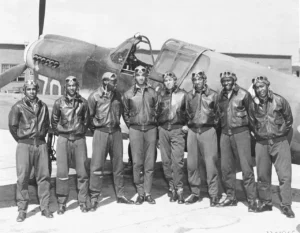
None of it stopped them. The Tuskegee Airmen of the 332nd Fighter Group flew over 15,000 missions in the skies over North Africa and Italy, earning 96 Distinguished Flying Crosses and other accolades.

The 761st Tank Battalion—”Black Panthers”—fought with Patton’s Third Army across France, Belgium, and into Germany. After arriving in France in 1944, the battalion entered combat and went on to endure 183 straight days in combat, helping liberate 30 towns as it pushed into Germany. Their battlefield record crushed the racist assumptions that had helped keep the Army segregated in the first place.

At Pearl Harbor, steward Doris “Dorie” Miller, never trained on shipboard weapons, grabbed a machine gun mid-attack aboard the USS West Virginia and became the first Black American to receive the Navy Cross.
Coming Home to a Country Unprepared to Honor Them
When the war ended, Black veterans came home to white mobs, violent police, and systematic denial of G.I. Bill benefits. Sergeant Isaac Woodard, still in uniform days after his discharge, was beaten and permanently blinded by a South Carolina police chief. Six returning veterans were lynched.

The outrage reached President Truman, who reportedly declared: “We’ve got to do something.” On July 26, 1948, he signed Executive Order 9981, officially desegregating the U.S. Armed Forces. The last all-Black Army unit was disbanded in 1954.
The Double V had taken longer than anyone hoped. But the men who flew over Anzio, rolled through the Ardennes, and died in the Pacific had proved the argument against their equality to be exactly what it was—a lie.
Today, that is the war story worth remembering.