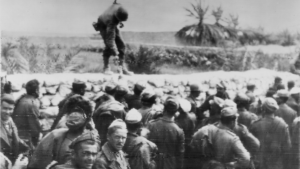
83 Years Ago Today, a Band of American Soldiers Pulled Off One of WWII’s Most Remarkable Comebacks, and Changed the Course of the War in North Africa.
It was March 23, 1943. The Tunisian desert was pitch black and bitterly cold. American soldiers were hacking at the rocky ground with picks and shovels, preparing positions they hoped would hold. Just miles away, the steel bulk of German Panzers was quietly assembling in the darkness. Nobody knew it yet, but this morning would mark a turning point in American military history.
From Disaster to Determination: The Shadow of Kasserine Pass
To understand why El Guettar mattered so much, you have to go back just four weeks earlier. The U.S. II Corps had been badly mauled in its first serious encounter with Axis forces in Tunisia, in a series of battles that culminated in the disastrous Battle of Kasserine Pass in late February 1943. The defeat was humiliating. American troops had been outgunned, outmaneuvered, and routed. Confidence in U.S. leadership was at rock bottom.
Dwight D. Eisenhower, Supreme Commander of the Allied Forces, removed Maj. Gen. Lloyd Fredendall, and George S. Patton took command of II Corps on March 6, 1943, inheriting a force of roughly 88,000 men and a huge mission.

General Patton set to work implementing iron discipline within his troops—even fining soldiers found without proper uniform neckties and leggings. His methods were blunt, even brutal, but they worked. Within days, a beaten force had found its spirit of defiance again.
Darby’s Rangers Take El Guettar
On March 18, 1943, the 1st Ranger Battalion—commonly referred to as Darby’s Rangers for their commander, William O. Darby—captured El Guettar, a town in central Tunisia where roads from the south and the coast converge. Situated north of a lake and south of desert hill ridges, El Guettar was a critically important geographic position for the Allies to maintain pressure on the Germans in North Africa.

The stakes were enormous. If the Americans could push east from El Guettar to the coast, the entire German force in southern Tunisia would be cut off. The Wehrmacht couldn’t allow that to happen.
Dawn Attack: 50 Panzers Roll Into the Valley
At 6 a.m. on March 23, fifty tanks of the 10th Panzer Division emerged from the pass into the El Guettar valley, followed by Marder tank destroyers and panzergrenadiers. The Germans quickly overran front-line infantry and artillery positions.
The German force, assembled about nine miles east of El Guettar, consisted of around 6,000 men, 50 serviceable Panzers, a company of tank destroyers, and an assault gun battery. The German commanders, who had seen American forces crumble at Kasserine, expected this to be easy.
They were wrong.

German morale took a hit when they ran into a minefield. When they slowed to clear the field, U.S. artillery and anti-tank guns opened up on them, including the potent M10 tank destroyers. Over the next hour, 30 of the 10th Panzer’s tanks were destroyed, and by midday, they retreated from the valley.
The Price of Victory
The win came at a cost. The 601st Tank Destroyer Battalion lost fourteen men and 21 of its 31 M3 halftrack tank destroyers.

22 US tanks were lost, and the total U.S. casualties for the broader El Guettar campaign ran to an estimated 4,000–5,000 killed or wounded—a sobering reminder that even victories carry a heavy price.

Why El Guettar Still Matters Today
This battle showed that the Americans, though still inexperienced, were now able to hold ground against offensives conducted by experienced German forces. It was the first proof of concept for what the U.S. Army would become: a force that could learn, adapt, and beat the best the Wehrmacht had to offer.
The opening of the Battle of El Guettar is depicted in the iconic 1970 movie Patton— but the real story is even more gripping than Hollywood’s version. Eighty-three years on, the sandy ridges of central Tunisia still bear silent witness to the day America’s soldiers refused to run.