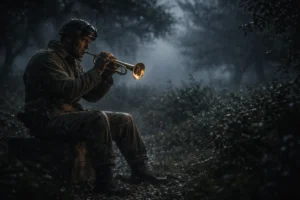
In the summer of 1944, the orchards of Normandy were a deadly labyrinth of hedgerows and hidden snipers. For the men of the Ninth Air Force, life was a cycle of high-speed ground attacks in P-47 Thunderbolts and tense nights on the ground dodging German “stay-behind” marksmen.
Captain Jack Tueller was one of those pilots. A former first-chair trumpet player for Brigham Young University, Tueller carried his horn on every one of his 100+ combat missions. He figured if he were ever shot down, the music would help him survive a POW camp. But he never expected it to save his life while he was still behind American lines.
The Sound-Aiming Threat

Two weeks after D-Day, Tueller’s unit was hunkered down in a dark, rain-soaked apple orchard. The area had been mostly cleared, but one German sniper remained active. This wasn’t just any marksman; he was reportedly using “sound-aiming” techniques, allowing him to fire accurately at anything he could hear in the dead of night.
Despite a direct warning from his commander that playing would be “his funeral,” Tueller was overwhelmed by the stress of constant combat. He reached for his trumpet.
A Song for the Enemy: Lili Marlene

Tueller didn’t play an American march or a jazz standard. Instead, he chose a song he knew every German soldier would recognize: Lili Marlene.
Originally a German poem from WWI, the song had become a massive hit for both Axis and Allied troops. Its themes of love, longing, and the loneliness of a sentry transcends political borders. As the melody drifted through the damp French night, the orchard went silent. Tueller finished the song, put his trumpet away, and waited. The sniper never fired.
The Morning After

The following morning, a group of German prisoners was being marched past Tueller’s position toward a transport for England. One 19-year-old German soldier stopped and asked the American MPs who had played the trumpet the night before.
When Tueller stepped forward, the young German burst into tears. In broken English, he explained that hearing Lili Marlene made him think of his fiancée and his mother back in Germany. He admitted that he had Tueller in his sights, his finger on the trigger, but he simply couldn’t bring himself to fire.
The two men—who had been trying to kill each other just hours earlier—shook hands.
A Life Defined by Music
Jack Tueller survived the war and went on to a long career in the newly formed U.S. Air Force, serving in both Korea and Vietnam before retiring as a Colonel. He passed away in 2016 at the age of 95, but he never stopped telling the story of the night music proved stronger than a sniper’s rifle.
“He was no enemy,” Tueller said years later. “He was a scared kid, like me. We were both doing what we were told to do.”