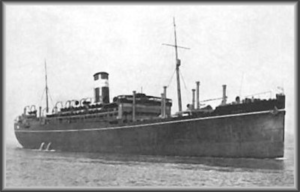
The sinking of the HMT Rohna was the most devastating naval incident of WWII, but it is often overlooked in history books

Photo Credit: George Duncan's Maritime Disasters of World War II / Unknown Source / Wikimedia Commons / Public Domain

The Japanese attack on Pearl Harbor on December 7, 1941, claimed the lives of 1,177 sailors aboard the battleship USS Arizona (BB-39). Moored near Ford Island and not underway at the time, the ship was catastrophically damaged during the assault, and its destruction soon became one of the most enduring symbols of the attack. Despite the scale of the tragedy, however, it was not the deadliest single naval disaster for American forces during World War II.

That grim distinction belongs to HMT Rohna, a British troop transport operating in the Mediterranean Sea. In 1943, the vessel was struck by a guided missile launched by the Luftwaffe while carrying more than 1,000 American troops. The sinking resulted in the loss of more U.S. service members than any other single naval incident of the war, making it one of the deadliest—and for many years largely overlooked—maritime disasters of the conflict.

Construction of the HMT Rohna

HMT Rohna at sea
HMT Rohna. (Photo Credit: Rohna Survivors Memorial Association / Wikimedia Commons / Public Domain)

The HMT Rohna was commissioned in 1925 when the British India Steam Navigation Company ordered two new vessels for service along the Madras–Nagapatam–Singapore route. Built by Hawthorn Leslie and Company at their Hebburn shipyard on the River Tyne, the ship was launched in August 1926 and completed later that year.

Originally intended as a passenger liner, the Rohna was capable of carrying up to 5,064 people on deck. Changes in maritime safety regulations later reduced that total to 3,851, but even so, it remained the largest passenger ship registered in the United Kingdom at the time. Given its impressive size and carrying capacity, it was unsurprising that the vessel was requisitioned for service as a troop transport during the Second World War.

Service during the early days of World War II

Members of the 51st Highland Division wading through water
51st Highland Division members coming ashore during Operation Husky, July 1943. (Photo Credit: Sgt. Frederick Wackett, No 2 Army Film & Photographic Unit / Wikimedia Commons / Public Domain)

The HMT Rohna was sailing the Indian Ocean when the UK entered World War II. Largely operating unescorted and occasionally traveling as part of convoys, she ferried thousands of troops to different areas, including through the Suez Canal and between Bombay, Marseille, Durban, Mombasa and Dar es Salaam.

Rohna was involved in several important campaigns early on in the Second World War. She ferried troops throughout the North African Campaign, as well as during the invasion of Sicily, which ended in an Allied victory and resulted in the collapse of Italian Prime Minister Benito Mussolini‘s regime. Lastly, the vessel ferried troops during the Allied invasion of Italy.

The HMT Rohna transported a number of American soldiers

Boeing B-29 Superfortress in flight
Boeing B-29 Superfortress. (Photo Credit: Unknown Author / United States Air Force / Wikimedia Commons / Public Domain)

In November 1943, the HMT Rohna set sail with 1,981 American soldiers bound for India. While the ship’s operations were overseen by British and Australian officers, most of the crew consisted of Indian sailors.

On board were servicemen from a range of specialized units, including the 853rd Engineer Battalion, Aviation; the 322nd Fighter Control Squadron; the 31st Signal Construction Battalion; and the 44th Portable Surgical Hospital Unit. Their mission was to help establish airbases in India to support the deployment of Boeing B-29 Superfortress bombers.

To strengthen the Rohna’s defenses against potential attacks, 18 American troops were assigned to operate the ship’s Oerlikon autocannons along with a QF 12-pounder naval gun.

Sinking of the HMT Rohna

USS Pioneer (AM-105) at sea
USS Pioneer (AM-105), 1943. (Photo Credit: navsource / U.S. Navy / Wikimedia Commons / Public Domain)

On the morning of November 25, 1943, the HMT Rohna and four other troop ships departed Oran, in French Algeria. The next day, the convoy came under siege by a group of Heinkel He 177A Greifs, Junkers Ju 88s and torpedo bombers. While the convoy was defended by Free French Air Force Supermarine Spitfires, there were only four up against over 20 Luftwaffe-flown aircraft.

The He 177As were armed with Henschel Hs 293 radio-guided glide bombs, which they dropped on the ships below. The majority were unsuccessful in hitting their targets, as the way they were released made it difficult to accurately hit. The convoy fought back with their anti-aircraft guns.

Around an hour in, Rohna was struck by a bomb on her port side, becoming the only casualty of the skirmish. Many onboard were injured or killed, while several escaped and boarded lifeboats. In total, 1,138 were killed, of which 1,015 were American, and 782 reached the lifeboats. They were later rescued by the cargo ship Clan Campbell and the Auk-class minesweeper USS Pioneer (AM-105), who themselves were protected by the Hunt-class destroyer HMS Atherstone (L05).

Legacy of the sinking

Walls at the north end of the sunken garden at the Merchant Seamen's Memorial
Those who perished during the sinking of the HMT Rohna are honored at the Merchant Navy War Memorial at Tower Hill in London, United Kingdom. (Photo Credit: Thryduulf / Wikimedia Commons CC BY-SA 4.0)

The sinking of HMT Rohna resulted in the immediate deaths of 1,015 American service members, with another 35 later succumbing to their injuries—making it the deadliest loss of U.S. lives at sea caused by enemy action during World War II. Despite the enormous toll, information about the disaster was strictly controlled. In January 1944, families received telegrams stating that their relatives were missing, only to be informed months later that they had actually been killed.

By February 1944, the press was told that more than 1,000 Americans had died in an unspecified maritime incident, but the ship’s identity and the full extent of the casualties remained classified until June 1945. Although it was eventually revealed that German aircraft had carried out the attack, the critical detail—that the vessel had been struck by radio-guided glide bombs deployed by the Luftwaffe—did not become public until 1967, after documents were released under the Freedom of Information Act. The secrecy had been intended to prevent Axis forces from confirming the effectiveness of their new weapon.

In the decades since, memorials honoring the victims have been established in several cities worldwide, including London, The Bronx in New York City, Seale, Alabama, Chittagong in Bangladesh, and Mumbai in India, ensuring that those lost in this long-concealed tragedy are properly remembered.

Todd Neikirk

Todd Neikirk is a New Jersey-based politics, entertainment and history writer. His work has been featured in psfk.com, foxsports.com, politicususa.com and hillreporter.com. He enjoys sports, politics, comic books, and anything that has to do with history.

When he is not sitting in front of a laptop, Todd enjoys soaking up everything the Jersey Shore has to offer with his wife, two sons and American Foxhound, Wally.