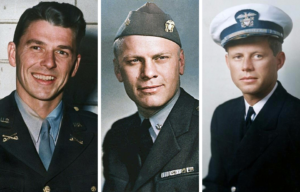
Gerald Ford

Following the Japanese attack on Pearl Harbor on December 7, 1941, Gerald Ford enlisted in the US Navy. Commissioned as an ensign in the US Naval Reserve, he commenced active duty at the V-5 instructor school in Annapolis, Maryland. He was then an instructor at the Navy Pre-Flight School in Chapel Hill, North Carolina, where, along with teaching, he coached such sports as swimming, football and boxing.
In June 1942, Ford was to lieutenant, junior grade. The following year, he received yet another promotion to lieutenant. Shortly thereafter, he became a part of the USS Monterey‘s (CVL-26) crew, serving aboard the light aircraft carrier until 1944.
As a member of Monterey‘s crew, Ford actively participated in various engagements, including the securing of Makin Island in the Gilbert Islands and several carrier strikes. He also took part in the Battle of the Philippine Sea and the American landings on Kwajalein, Eniwetok, Mindoro and Leyte.
Gerald Ford was reassigned to the US Navy Pre-Flight School

After the occurrence of Typhoon Cobra, Ford was reassigned to the Navy Pre-Flight School at Saint Mary’s College of California, where he worked with the Athletic Department until April 1945. He then served as a staff member at the Naval Reserve Training Command at Naval Air Station Glenview, Illinois.
Entering politics following WWII (he had attended law school, after all), the future US president was elected to the US House of Representatives, serving as House Minority Leader from 1965-73. He became vice president under Richard Nixon and took over the position when he resigned in 1974.
John F. Kennedy

In 1940, John F. Kennedy had planned to pursue law at Yale, but the looming war altered his path. Initially, his chronic back issues medically disqualified him from service, yet with the assistance of family friend Alan Kirk, Kennedy secured a commission in the U.S. Naval Reserve, opening the door to active duty in World War II.
John F. Kennedy was given command of PT-109

In 1943, eager to engage more directly in combat, John F. Kennedy used his connections to transfer to the Pacific Theater. He joined Motor Torpedo Squadron TWO and assumed command of PT-109, an 80-foot patrol torpedo boat. Later that year, the vessel was rammed by the Japanese destroyer Amagiri, killing two crew members. The surviving sailors swam roughly 3.5 miles to Plum Pudding Island after their boat was destroyed.
Ronald Reagan

Ronald Reagan was already an actor when he enlisted in the US Army Reserve in 1937, having starred in such films as Love Is on the Air (1937). He continued to act while in the reserves, but was called up to active service as relations between the United States and Japan continued to sour.
Reagan transferred to the US Army Air Forces (USAAF) and became a public relations officer with the service. His poor eyesight meant he was ineligible for deployment overseas and he served out the Second World War in the US. He was assigned to the 1st Motion Picture Unit and, by the end of the conflict, had risen to the rank of captain. As well, he produced over 400 training films for the USAAF.
Ronald Reagan continued acting after World War II

Following the war, Reagan continued his Hollywood career, serving as the president of the Screen Actors Guild (SAG). During this time, he became interested in politics and, in 1966, announced he’d be running for California governor. He secured a resounding victory, which served as a predictor of his presidential win over a decade later.
Richard Nixon

When World War II began, Richard Nixon was working in a civilian capacity for the Office of Price Administration. Although his Quaker faith could have granted him a draft deferral, Nixon found little fulfillment in remaining stateside and chose instead to join the U.S. Naval Reserve. His service saw him advance to the rank of lieutenant, junior grade.
In October 1942, Nixon was assigned as an aide at Naval Air Station Ottumwa in Iowa, a posting that largely involved administrative duties. Restless with desk work, he requested a more hands-on assignment and soon secured a transfer overseas. He was sent to Marine Aircraft Group 25 and later attached to the South Pacific Combat Air Transport Command (SCAT), where his work in aviation logistics played an important role in supporting Allied operations throughout the Pacific theater.
Richard Nixon was posted at Alameda Naval Air Station, California

Nixon led SCAT forward detachments at Bougainville, Vella Lavella, and Nissan Island before returning to the U.S. for an assignment at Alameda Naval Air Station in California. He was later transferred to the Bureau of Aeronautics and was released from active duty in 1946.
Like several others who served in World War II, Nixon rose through the political ranks after the war. He was elected to both the U.S. House of Representatives and the Senate before launching a presidential campaign. He eventually became president, serving until 1974, when he resigned following the Watergate Scandal.
Lyndon B. Johnson

When the Japanese attacked Pearl Harbor on December 7, 1941, Lyndon B. Johnson had already been a US Congressman for four years. A member of the US Naval Reserve, he was called up to active service just three days later. Johnson was close with then-US President Franklin D. Roosevelt, who’d entered the United States into WWII on December 8, and FDR assigned him to survey the conditions in the Southwest Pacific.
Johnson reported to Gen. Douglas MacArthur, who, at the time, was stationed in Australia to oversee strikes against the Japanese in New Guinea. The future president volunteered to be an observer on one of these bombing runs, and he’d wind up receiving the Silver Star for keeping his cool when the aircraft he was aboard suffered mechanical problems mid-flight.
Lyndon B. Johnson advocated for better conditions for troops

Using his camera, Johnson advocated for better conditions for those troops serving in the Pacific and wound up being appointed the chairman of a subcommittee of the Naval Affairs Committee. He was subsequently released from active duty and went on to continue his career in politics, serving in the US Senate and, later, as vice president under John F. Kennedy.
Following the events of November 22, 1963, he was sworn in as president, serving from 1963-69.
George H.W. Bush

George H.W. Bush grew up wealthy, the son of banker and politician, Prescott Bush. Despite his social standing, the future US President was eager to participate in WWII. He enlisted in the US Navy on the day he turned 18, receiving a commission as an ensign in the Naval Reserve. Impressively, he was one of the youngest pilots the service had ever employed.
Piloting the Grumman TBF Avenger, the young Bush flew his first combat mission against the Japanese on Wake Island in 1944, having been deployed to the Pacific Theater aboard the USS San Jacinto (CVL-30). He had a close brush with death that August when his aircraft was shot down during an attack on Chichijima. He was subsequently rescued by the USS Finback (SS-230), but his fellow aviators weren’t so lucky. Some were captured and cannibalized by their captors after being killed.
George H.W. Bush continued to serve in the Pacific Theater

While understandably shaken up by this experience, Bush continued to serve in the Pacific, participating in combat action over the Philippines. He also trained for the proposed invasion of the Japanese mainland, but this operation was called off when the enemy surrendered following the atomic bombings of Hiroshima and Nagasaki.
After being relieved of active service, Bush found work in the oil industry. It wasn’t until 1963 that he became involved in politics, serving in several roles under various presidents, before securing the office himself. He led the US from 1989-93.
Dwight D. Eisenhower

Unlike the other men on this list, Dwight D. Eisenhower had spent his entire life in the military when WWII came around. In fact, he is the only US president to have served in both WWI and WWII. He enrolled in the US Military Academy West Point in 1911, graduating four years later. He relished in the discipline and tradition of West Point, an early indication he was made to become a great leader.
Eisenhower was subsequently commissioned as a second lieutenant and assigned to Fort Sam Houston, Texas. Serving Stateside with the 65th Brigade Engineer Battalion during the First World War, he was subsequently moved to Camp Colt, Pennsylvania to lead a training unit of the newly-formed Tank Corps.
During the interwar period, Eisenhower served under many great military leaders – John J. Pershing and Douglas MacArthur among them – and served a tenure in the Philippines, working with the government to develop a capable army. He returned to America in December 1939.
Dwight D. Eisenhower helped plan the American war strategy

After the Japanese attack on Pearl Harbor on December 7, 1941, Eisenhower was called to Washington, DC, with Gen. George Marshall asking him to help plan the nation’s war strategy. Just under a year later, he was named Supreme Commander Allied Expeditionary Force of the North African Theater of Operations (NATOUSA) and quickly learned how to lead in times of great crisis while commanding his men throughout Operation Torch. Following this, he led the Allied invasion of Sicily.
In December 1943, President Franklin D. Roosevelt declared Eisenhower the Supreme Allied Commander. While in this role, he oversaw the Allied invasion of Normandy and the larger movement through France and the rest of German-occupied Europe. He also made a concerted effort following the war to document the atrocities committed by the German regime, to ensure what they did was never forgotten or misconstrued.
More from us: Johnnie Johnson: The Highest-Scoring Western Allied Air Ace of World War II
Eisenhower was incredibly popular among the American public following WWII, leading his constituents to recommend he try his hand at running for president. His campaign was successful, and he served from 1953-61. He was also promoted to the prestigious rank of five-star general in 1944.