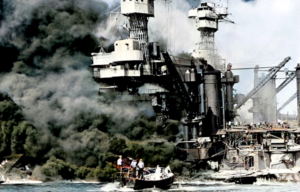
Three young sailors survived the sinking of the USS West Virginia during Pearl Harbor, but there was no way to rescue the men who were trapped inside the vessel for weeks
Photo Credit: U.S. Navy, Office of Public Relations / Wikimedia Commons / Public Domain (Colorized)
On the morning of December 7, 1941, Japanese forces struck the U.S. Pacific Fleet at Pearl Harbor with sudden, overwhelming force. Nearly 2,400 Americans lost their lives, and within hours the United States was fully engaged in World War II. Among those killed were three servicemen whose contributions have largely faded from public memory, despite the critical roles they played amid the chaos.
Each man was aboard a ship in the thick of the assault, carrying out his duties as bombs fell, fires erupted, and enemy aircraft roared overhead. Their actions went largely unreported, eclipsed by the scale of the attack itself. Yet their bravery was genuine, and their sacrifice carried profound significance.
While Pearl Harbor is remembered as a pivotal moment in American history, it is also composed of countless individual acts of courage and duty. These three men remain emblematic of that legacy—silent witnesses to the courage of ordinary service members whose resolve, though often unseen, shaped the outcome of history.
The USS West Virginia was on fire for 30 minutes before sinking
USS West Virginia, 1940s. (Photo Credit: Frederic Lewis / Getty Images)
The USS West Virginia was hit by two overhead bombs and at least six torpedoes during the attack. Immediately after, officers aboard the ship called a “setting condition Zed,” a naval technique wherein all hatch compartments are closed and a portion of the ship flooded to keep it from capsizing.
It was ablaze for 30 hours before sinking and settling along the bottom of the harbor, 40 feet below the water. According to the National Park Service, 106 crew members were killed.
A banging sound was heard inside the ship
Explosion at the Naval Air Station during the attack on Pearl Harbor. (Photo Credit: Fox Photos / Getty Images)
The following day, those who’d survived the attack began cleanup efforts, during which they heard a banging noise coming from the USS West Virginia. At first, they thought it was a piece of loose rigging hitting the hull. However, they soon realized they were hearing the sounds of those trapped inside the wreckage.
“When it was quiet you could hear it… bang, bang, then stop. Then bang, bang, pause. At first, I thought it was a loose piece of rigging slapping against the hull. Then I realized men were making that sound – taking turns making noise,” said bugler Dick Fiske.
It was impossible to rescue the men
USS West Virginia off Pearl Harbor, April 1943. (Photo Credits: Official U.S. Navy photo 80-G-K-571 / U.S. Navy Naval History and Heritage Command / Wikimedia Commons / Public Domain)
The faint, anguished cries echoing from deep within the sunken USS West Virginia lingered above the water, a haunting reminder of the sailors trapped below. Rescuers faced a dire predicament: cutting through the ship’s thick steel hull risked flooding, while employing a torch could trigger a deadly explosion. With no safe way to reach them, hope for those trapped vanished.
Six months later, when salvage crews finally lifted the battleship from the harbor, they were met with a heartbreaking scene. In storeroom A‑111, they found three young men—18-year-old Ronald Endicott of Washington, 21-year-old Louis “Buddy” Costin of Indiana, and 20-year-old Clifford Olds of North Dakota—huddled together in their final moments. Their still, frozen forms bore silent testimony to the unimaginable danger they faced and the profound human toll of the Pearl Harbor attack.
The Navy never told their families what happened
Flashlight batteries, a manhole for fresh water, and leftover emergency rations were also found. A calendar was discovered with sixteen days crossed off in red pencil, from December 7 to December 23. This revealed that the three men had survived in the wreckage for over two weeks without any way to escape.
USS West Virginia on fire after being hit during the attack on Pearl Harbor. (Photo Credit: Universal History Archive / UniversalImagesGroup / Getty Images)
News of the discovery spread quickly through Pearl Harbor, but the Navy never informed the men’s families about how long they had remained alive. It wasn’t until decades later, in 1995, that their loved ones finally learned the truth when journalist Eric Gregory wrote a piece about the attack in the Honolulu Advertiser.
All three headstones say they died on the day of the attack
Following its discovery, the calendar was sent to the chief of naval personnel in Washington, D.C., and its current location is unknown. Following their recovery, Endicott and Costin were buried at the National Memorial Cemetery of the Pacific – known as the “Punchbowl” – in Honolulu. Olds’ remains were returned to his hometown and buried in the local cemetery.
All three of their headstones say they died on December 7, 1941, the day of the attack.
National Memorial Cemetery of the Pacific. (Photo Credit: Gerald Watanabe / Wikimedia Commons CC BY-SA 4.0)
Following it being raised, the USS West Virginia was repaired. When it was returned to service in April 1944, it played a key role in the US forces’ efforts against Japan, and was present at Tokyo Bay during the Japanese surrender. It was decommissioned in 1957 and sold for scrapping two years later.