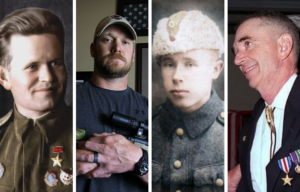
Chris Kyle – Most lethal sniper in US military history

Self-proclaimed as the “most lethal sniper in US military history,” Chris Kyle achieved 160 confirmed kills (nearly double that by some accounts) during his four tours in Iraq. As a US Navy SEAL, he earned the nickname “The Legend” among US Marines, while his enemies dubbed him “The Devil of Ramadi.” His skills with a rifle were such that multiple bounties were put on his head, in an attempt to bring his killing of insurgents to an end.
Kyle was initially interested in joining the US Marine Corps special operations, but opted to enlist with the Navy instead, after a recruiter spoke to him about becoming a SEAL. After undergoing extensive training, he was assigned to SEAL Team Three.
Kyle scored his first long-range kill when he was ordered to shoot a woman approaching a group of Marines while holding a hand grenade. During his four tours, he was shot and found himself caught up in six separate Improvised Explosive Device (IED) explosions. This didn’t stop him from continuing as a sniper, however, and he went on to receive one Silver Star and three Bronze Stars with Valor, among other decorations.
Kyle was honorably discharged in 2009, and was unfortunately killed by a fellow veteran struggling with mental health issues in February 2013. The film, American Sniper, was released the following year and is loosely based on the memoir he wrote prior to his death, American Sniper: The Autobiography of the Most Lethal Sniper in U.S. Military History. While many have accused Kyle of embellishing his accomplishments in the book, there’s no doubt he led an impressive naval career.
Vasily Zaytsev – Hero of the Soviet Union

Vasily Zaytsev became a World War II legend with 225 confirmed kills, most during the fierce Battle of Stalingrad. Growing up in the Russian wilderness, he honed his shooting skills hunting game to help feed his family—skills that would later make him one of the Soviet Union’s deadliest snipers.
Before the war, Zaytsev worked as head of the finance department in the Soviet Pacific Fleet. When he volunteered for combat, his remarkable marksmanship quickly earned him a transfer to the 1047th Rifle Regiment of the 284th “Tomsk” Rifle Division under the 62nd Army.
One of Zaytsev’s most famous tales is a sniper duel with a German ace named Erwin König. Zaytsev claimed to have killed König in a tense showdown, though some historians question whether König even existed, citing a lack of official records. Still, wartime documentation was often unreliable, and the story has endured.
Zaytsev was wounded by a mortar blast in January 1943, but he didn’t stay out of action long. He was named a “Hero of the Soviet Union” and returned to combat a month later, continuing to fight all the way to the Battle of Seelow Heights near the war’s end.
Carlos Hathcock – Deadliest American sniper of the Vietnam War

Carlos Hathcock became one of the most feared snipers of the Vietnam War, driven by a strong commitment to protecting his fellow Marines. In 1965, he won the Wimbledon Cup Shooting Championship, showcasing his exceptional marksmanship skills—abilities that would prove invaluable when he deployed in 1966.
Hathcock once said, “If I didn’t get the enemy, they were going to kill the kids over there.” This mindset fueled his actions in Vietnam and highlighted his unwavering determination. While serving with the sniper platoon of the 1st Marine Division, he famously crawled over 1,500 yards over three days—without food or water—to track and eliminate a general in the People’s Army of Vietnam (PAVN). He made the kill shot from 700 yards away and disappeared into the jungle without being detected.
Hathcock also eliminated an enemy sniper known as “Cobra,” who had killed several Marines, as well as a female Viet Cong leader called “the Apache woman,” though historians continue to debate whether she actually existed. He had 93 confirmed kills but believed his true count was closer to 300 to 400.
Simo Häyhä – Deadliest sniper in history

Simo Häyhä—known to Soviet troops as the “White Death”—began life as a quiet farmer in Finland but became one of the most lethal snipers in history during the Winter War. When the Soviet Union invaded Finland, Häyhä stepped forward to serve and, in fewer than 100 days, was credited with over 500 confirmed kills, with some estimates reaching closer to 700. His extraordinary accuracy and ability to disappear into the snow unnerved Soviet forces so much that they deployed counter-sniper teams and even artillery strikes to eliminate him—without success.
Häyhä’s effectiveness came from his focus on simple, reliable tactics. He used a standard service rifle with iron sights, avoiding the glare that a scope might produce and reveal his position. To stay concealed, he kept snow in his mouth to reduce visible breath and packed snow around his firing position to muffle sound and blend into the environment. His patience, discipline, and exceptional aim made him a nearly invisible presence on the battlefield—relentless, precise, and firmly embedded in wartime legend.
More from us: Grease Gun: The US Military’s Longest-Serving Submachine Gun