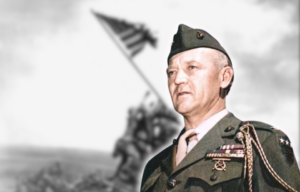
Graves Erskine’s upbringing and early life

Graves Erskine’s service during World War I

In January 1918, Graves Erskine went to France as a platoon leader with the 6th Marine Regiment. Although the First World War had less than a year remaining, the Marine participated in several crucial and high-profile battles, notably the renowned Battle of Belleau Wood. Taking place from June 1-26, 1918, during the German spring offensive, the engagement was a pivotal moment in US Marine Corps history, solidifying the service’s reputation as a battle-ready force.
Erskine also played a role in the Battle of Château-Thierry, where he sustained injuries. Additionally, he was wounded during the Saint-Mihiel Offensive in September 1918, an operation in which Gen. John Pershing aimed to break through the German line and capture Metz.
Following these experiences, he was repatriated to the United States, where he underwent nine surgeries and spent over a year in the hospital.
Transporting the Unknown Soldier

In 1921, Captain Graves Erskine served aboard the USS Olympia (C-6) as part of a Marine detail assigned to escort the remains of an unidentified American soldier—later honored as the Unknown Soldier—back to the United States.
The casket was secured to the deck of the ship, and under Erskine’s command, Marines took turns standing guard in four-hour shifts to ensure constant watch. During the voyage, the Olympia encountered the powerful Tampa Bay hurricane, one of the most destructive storms in U.S. history. Even as the ship was battered by the storm, the Marines stayed focused on their mission, protecting the casket at all costs.
When they arrived in Washington, DC, a Marine honor guard carried the Unknown Soldier’s casket ashore, while the rest of the unit stood at attention and saluted, paying their respects in a solemn and dignified ceremony.
Graves Erskine’s service during World War II

In 1928, Graves Erskine was deployed to Nicaragua as part of the 2nd Marine Brigade. His responsibilities expanded as he assumed the role of bodyguard for Nicaraguan President José María Moncada Tapia, a position that emerged from his work with the Nicaragua National Guard Detachment. Erskine also led a battalion in operations against bandits in the country’s northern regions.
Throughout the interwar years, Erskine steadily rose in rank. As World War II began, he served as the chief of staff for the Amphibious Force, Atlantic Fleet, and by September 1942, he held the same position with the Amphibious Corps, Pacific Fleet. His contributions in the Pacific Theater earned him a promotion to brigadier general the following year.
Erskine played a important role in several key offensives, including those on Tinian, Saipan and the Kwajalein Atoll. However, his most notable accomplishment came during the Battle of Iwo Jima.
After being promoted to major general, Erskine took command of the 3rd Marine Division, a crucial U.S. military unit in the assault on Iwo Jima. The American victory there, much like the heroism displayed at Belleau Wood, solidified its place as one of the Marine Corps’ most legendary battles.
Graves Erskine’s later life

After World War II, Erskine continued his military career with a focus on supporting Marines transitioning back to civilian life. He initially worked on developing programs designed to ease this process, before being called to Washington to serve as the administrator for the Retraining and Reemployment Administration (RRA).
Following his time in the capital, Erskine returned to active duty, taking on leadership roles at Marine Corps Base Camp Pendleton in California. He also served as the deputy commander of the Fleet Marine Force, Pacific. In July 1951, he was appointed commanding general of the Fleet Marine Force, Atlantic, a position he held until his retirement in 1953.
Upon his retirement from the Marine Corps, Erskine was promoted to four-star general, a recognition of his bravery and leadership in combat.
More from us: The Enduring Legacy of Submarine Commander Dudley Morton