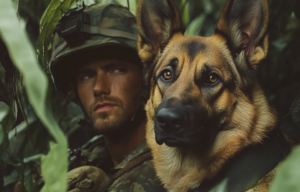
In the dense jungles of Vietnam, some of the U.S. military’s most reliable partners weren’t human—they were dogs. These canine soldiers carried out critical missions: detecting concealed booby traps, patrolling and securing camps, scouting enemy positions, and even delivering messages under fire. Their extraordinary senses provided an edge no equipment could match. Time after time, they faced deadly danger to protect their handlers, often at the cost of their own lives. Today, veterans continue to honor these remarkable animals, remembering them as enduring symbols of courage, loyalty, and selfless service.
Not the first war dogs
American servicemen and their dogs awaiting their next assignment in a Bougainville jungle clearing, 1944. (Photo Credit: Bettmann / Getty Images)
Dogs have long played a role in warfare, but it wasn’t until World War II that the U.S. began officially training dogs for combat duties. Between 1943 and 1945, the Marine Corps began preparing dogs—especially Doberman Pinschers—for service in the Pacific, where they took on crucial responsibilities like carrying messages and guarding camps. Their effectiveness on the battlefield quickly earned them a place as essential military assets.
This early success laid the foundation for the reintroduction of K9 units during the Vietnam War. Though official documentation is limited, it’s believed that approximately 5,000 dogs were deployed from 1968 onward, supported by close to 10,000 trained handlers. Tragically, unlike their human counterparts, many of these dogs never returned home. Instead, they were either left behind or reassigned, a somber reminder of the deep but often overlooked cost of war.
Use as tracking dogs in Vietnam
Australian servicemen with their tracking dogs, 1967. (Photo Credit: Bryan Campbell / Australian War Memorial / Wikimedia Commons / Public Domain)
Labrador Retrievers were one of the dog breeds used in Vietnam, mainly for tracking. They were trained to alert their handlers to snipers, tripwires, and hidden weapons. Vietnam War veteran Rick Claggett explained that they were especially good at following blood trails. A typical Lab team was made up of the dog, its handler, a cover man, the team leader, and a visual tracker, and they were sent out when troops needed to find a wounded enemy or a missing person.
Labradors were chosen over other breeds like Beagles and Bloodhounds because they made less noise.
In Australia, K9 units were created using 11 shelter dogs adopted from Sydney. These dogs were named after Roman emperors and were expected to serve in Vietnam for three years. While they sometimes worked with American troops, the main breed used by the Australians was the German Shepherd.
Sentry and scouting duties
Muzzled sentry dogs and their handlers returning to their kennels and barracks after patrolling the perimeter of the Marble Mountain supply and communications center outpost in Đà Nẵng, 1969. (Photo Credit: R.A. Elder / Hulton Archive / Getty Images)
During the Vietnam War, military dogs demonstrated remarkable versatility, undertaking a variety of important roles such as sentry duty, scouting, mining, tunneling, and tracking. Rick Claggett, who worked with Big Boy, one of these expertly trained canine scouts, recalled their primary task: leading patrols through fields. These dogs were meticulously trained to detect booby traps and ambushes by scent, a skill that made their position at the forefront of such missions particularly dangerous. According to Claggett, this role carried the third-highest mortality rate during the conflict.
Sentry dogs were deployed to patrol the perimeters of U.S. outposts, acting as the first line of defense against enemy forces. German Shepherds were also used in water patrols, using their keen senses to detect enemy soldiers concealed underwater, ready to attack amphibious craft. The exceptional effectiveness of these teams made them valuable targets for Viet Cong guerrillas, who offered bounties for both the dogs and their handlers, even going so far as to attack their kennels to claim the rewards.
Nemo A534
Nemo A534 and Capt. Robert Sullivan during a demonstration in Denver, Colorado, 1967. (Photo Credit: The Denver Post / Getty Images)
Few stories capture the bond between soldier and dog more powerfully than the heroic partnership of Nemo A534 and his handler, Captain Robert Throneburg.
On December 4, 1966, while patrolling Tan Son Nhut Air Base, Nemo detected Viet Cong fighters concealed nearby and alerted Throneburg. A fierce firefight erupted moments later. Throneburg was shot twice in the shoulder, and Nemo took a round through the muzzle that exited beneath his eye.
Even gravely wounded, Nemo refused to abandon his partner. Bleeding and in agonizing pain, he crawled to Throneburg and positioned himself over the downed captain, growling and guarding him against anyone who approached. His actions bought critical time until medics could reach the scene—time that likely saved Throneburg’s life.
Throneburg later received the Bronze Star with Valor and two Purple Hearts for his actions. Nemo was returned to the United States, retired from combat, and continued to serve as a recruiting dog, becoming a lasting symbol of courage, loyalty, and the unbreakable bond between war dogs and their handlers.
Man’s best friend
Airman restraining a German Shepherd undergoing sentry training at Lackland Air Force Base, Texas, 1965. (Photo Credit: Pix / Michael Ochs Archives / Getty Images)
These dog/handler teams were invaluable to the war effort in Vietnam. They were credited with saving the lives of around 10,000 servicemen, thanks to their various roles in the conflict. James Mulligan handled scout dog Rickey, who “never walked our patrol into an ambush or any booby traps. He alerted on 45 ambushes, five in one day.”
While these actions were appreciated by the men that served alongside them, these dogs weren’t made a priority when the war came to an end. Of the roughly 5,000 that served, around 232 were killed in action (KIA) and another 200 were assigned to posts outside of the US. The remainder were either left in the hands of the Vietnamese or abandoned. At least 2,000 were simply euthanized.
The US government viewed them as “equipment” and didn’t want to fund their trips home. Having built such strong bonds, many soldiers wanted to bring their comrades back to the US with them, but were still told no, despite repeated appeals to Congress and the press.
The service performed by these canines never went forgotten, and there are countless interviews with veteran handlers who still remember their partnerships fondly. In 2019, they were publicly remembered when the Vietnam War Dog Team Memorial was unveiled at Motts Military Museum, Inc. in Ohio.