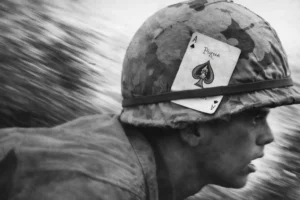
If you look closely at combat photography from the Vietnam War, one unofficial insignia appears more than any other: the Ace of Spades. Tucked into the elastic M1 helmet bands of infantrymen or painted onto the noses of Huey helicopters, the card became a ubiquitous icon of the American experience in Southeast Asia.
While the image was forged in the jungles of the 1960s, it was immortalized by Hollywood. With the eerie “calling card” scenes in Apocalypse Now, cinema has cemented the Ace of Spades as the ultimate symbol of the infantrymen who faced the daily grind of ground combat. In the popular imagination, it is a psychological weapon that struck fear into the hearts of the enemy.
To the men on the ground, the meaning was simple: It was a message to the jungle that they were still there, still fighting, and still holding the high card.
The Origins: From the 101st Airborne to the Delta

The spade was not a Vietnam-era invention. During World War II, the 506th Parachute Infantry Regiment (101st Airborne Division) painted spades on their helmets to identify themselves during the chaotic drops over Normandy.
However, by 1966, the spade had evolved from a unit marker into a psychological “calling card.” Soldiers in the field began requesting decks consisting entirely of Aces of Spades from the United States Playing Card Company. In an act of wartime support, the company shipped thousands of these “special decks” to troops for free, often labeled as “Bicycle Secret Weapon” crates.
PSYOP or Superstition? The Great Cultural Gap

The most enduring legend is that the Ace of Spades was used to terrify the Viet Cong (VC) and the North Vietnamese Army (NVA). American intelligence officers believed that the spade represented an omen of death in Vietnamese culture.
The Reality Check: Historians and cultural experts have since noted a major flaw in this strategy: The spade meant nothing to the Vietnamese. The French had introduced playing cards to Vietnam, but the traditional Vietnamese deck looked nothing like the Western 52-card set. To a VC guerrilla, an Ace of Spades was simply a strange piece of foreign paper.
Despite the lack of cultural impact on the enemy, the “Death Card” remained a powerful tool for American morale.
- The “Calling Card”: Leaving a card on a cleared position or a fallen enemy soldier gave U.S. troops a sense of dominance in a war where the enemy was often invisible.
- The Psychological Edge: If the soldiers believed the enemy feared the card, it increased their own confidence during patrols.
A Symbol of Individualism in a Fragmented War

Unlike World War II, where units stayed together for the duration, the Vietnam “individual rotation” system meant soldiers often felt like cogs in a machine. Informal symbols—helmet graffiti, peace signs, and the Ace of Spades—became a way to reclaim identity.
The card signaled that the wearer was a “combat veteran”—someone who had seen the “elephant” and survived. It was a mark of gallows humor, a grim acknowledgment of the high stakes of every jungle patrol.