March 3, 2026, arrives just days after the fourth anniversary of Russia’s full-scale invasion of Ukraine was marked at the United Nations, a reminder that borders and security guarantees in Eastern Europe are still painfully live questions.
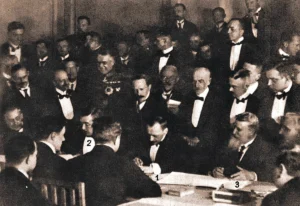
On March 03, 1918, Bolshevik Russia signed the Treaty of Brest-Litovsk—an emergency “peace” that yanked Russia out of World War I and redrew the map from the Baltic to the Black Sea.
March 3, 1918: A Peace Signed Under the Gun

After the 1917 revolutions and the collapse of Russia’s war effort, Lenin’s new government needed breathing room—fast. Negotiations with the Central Powers at Brest-Litovsk (now Brest, Belarus) lurched forward, but Germany resumed operations in February 1918 and advanced rapidly, leaving the Soviets with little leverage.
The treaty was signed on March 3, ratified by Soviet authorities on March 15, and later voided after Germany’s defeat in November 1918—but its brief life left a long shadow.
What Russia Gave Up at Brest-Litovsk
Brest-Litovsk was not a tidy exit; it was a strategic retreat at enormous cost. Russia accepted terms that stripped away control or claims over Ukraine, its Polish and Baltic territories, and Finland—territories that mattered not just for prestige, but for people, farmland, and industry.
The settlement shocked contemporaries because it treated whole regions as chips in a great-power bargain, while local national movements were suddenly forced to fight—politically and militarily—for what “independence” would actually look like on the ground.
The Dominoes: From the Eastern Front to a New Map

In WWI terms, the immediate effect was operational. With the Eastern Front effectively neutralized, Germany could move forces west—helping set the conditions for the desperate offensives of 1918, launched before American manpower fully tipped the balance.
But in Eastern Europe, Brest-Litovsk did something even more volatile: it sped up state-making under crisis. Ukraine, the Baltics, and Poland became arenas where armies, militias, and rival governments competed to define borders in real time.
That instability didn’t evaporate when the treaty was annulled. The Russian Civil War and the postwar settlement produced borders that were fought over, revised, and remembered. Brest-Litovsk became an early preview of a recurring pattern: when empires fracture, the struggle is not only over territory, but over which political project gets to call that territory legitimate.
Why Brest-Litovsk Still Echoes in 2026

Fast-forward 108 years, and Eastern Europe is again building security architecture for a world where borders feel less settled than they did a generation ago. Analysts describe Europe’s security environment as the most dangerous in decades, with NATO’s eastern flank under intense focus.
Recent moves—from Poland’s decision to leave the Ottawa Convention (opening the door to rapid mining of its eastern border) to new work on hardened defenses in the Baltic region—show how quickly strategy shifts when leaders fear surprise, coercion, or a sudden change in the map.
Brest-Litovsk explains the historical muscle memory: the fear of being negotiated over, the urgency of defensible borders, and the way a single punitive deal can echo for generations.
On March 3, it’s worth remembering how one signature in a railway town helped turn Eastern Europe into the central strategic frontier of the 20th century—and, in many ways, of the 21st.