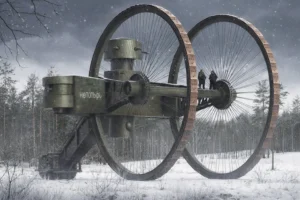
Modern military power is measured by stealth and precision, but in 1914, Imperial Russia bet its future on a machine that looked like a steampunk nightmare. The Tsar Tank, a massive iron tricycle, promised to end the stalemate of the Great War. Instead, it became one of the most expensive and immobile “toys” in military history.
A Design Inspired by a Wind-Up Toy

The Tsar Tank, officially the Lebedenko Tank, wasn’t inspired by traditional armored vehicles. Its designer, Nikolai Lebedenko, was allegedly inspired by the high-wheeled carts used in Central Asia.
To secure funding, Lebedenko presented a small, wind-up wooden model of the tank to Tsar Nicholas II. The Tsar was so delighted by the toy’s ability to climb over stacks of thick books that he immediately authorized the project, granting it a several hundred thousand ruble budget. This connection to the Romanovs adds a layer of tragic irony to the machine; like the Empire itself, the tank was majestic in appearance but fundamentally unstable.
Technical Specs: The Giant Tricycle

The dimensions of the Lebedenko Tank were unlike anything seen on the Western Front. While British tanks like the Mark I focused on caterpillar tracks, Russia went for sheer scale:
- Front Wheels: Two massive spoked wheels roughly 9 meters (30 feet) in diameter.
- Rear Wheel: A smaller, weighted roller designed for steering.
- Armament: A central hull and sponsons housing 7.62mm Maxim machine guns and potentially 76mm cannons.
- Power: Two 240hp Maybach engines, scavenged from a downed German Zeppelin.
The logic was simple: wheels that high could theoretically roll over the deep trenches and cratered landscapes of no-man’s-land.
The Fatal Flaw: Ground Pressure Physics

On paper, the Tsar Tank was an unstoppable juggernaut. In reality, it was defeated by the very soil it was meant to conquer.
The “Why” behind its failure comes down to weight distribution and ground pressure. While the massive front wheels could roll over trees, the entire weight of the 60-ton machine was disproportionately concentrated on the small rear wheel.
When testing began in a forest near Moscow in August 1915, the rear wheel immediately sank into the soft, marshy earth. The Maybach engines, powerful as they were, couldn’t provide enough torque to pull the “tail” out of the mud. Because the design lacked the surface area of continuous tracks, the tank effectively became a 60-ton anchor.
Why the Tsar Tank Matters Today

The Tsar Tank’s failure underscored a lesson that defines modern armored warfare: Mobility is a function of weight distribution, not just size. While Russia’s experiment stalled in the mud, British and French engineers moved toward the Holt tractor-style tracks. These tracks spread the vehicle’s weight over a large surface area, preventing them from sinking—the exact opposite of the Tsar’s tricycle.
The machine sat in the forest for years, a rusting monument to Romanov ambition, before being scrapped in 1923. For military history buffs, it remains a “fantastical” design that looks more at home in a Lucasfilm production than a WWI battlefield.