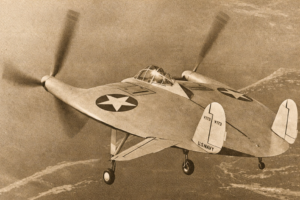
During World War II, military engineers weren’t afraid to challenge conventional thinking. While fighters like the F6F Hellcat and P-51 Mustang dominated the skies, another aircraft was quietly being tested that looked like it belonged in science fiction: the Vought V-173, better known as the “Flying Pancake.”
With its nearly circular wing and squat profile, the aircraft seemed almost absurd. Yet behind its unusual appearance was a serious attempt to solve one of naval aviation’s biggest challenges: short takeoffs and landings from aircraft carriers.
Why the U.S. Navy Needed Something Different

Carrier aviation in the early 1940s required aircraft that could take off quickly and land slowly without stalling. Long runways weren’t an option at sea, and deck space was always limited.
Aeronautical engineer Charles H. Zimmerman believed the answer wasn’t a longer wing—but a different wing entirely. His concept focused on creating an aircraft with a very low stall speed while maintaining stability and control.
The result was the V-173, built by Vought as a proof-of-concept test aircraft.
How the “Flying Pancake” Actually Worked

At first glance, the V-173’s round wing looks impractical. In reality, the broad, disc-like shape distributed lift across the entire surface. Combined with large propellers positioned at the front edges, the design helped control airflow and delay stall conditions.
The aircraft first flew in 1942 and quickly surprised skeptics. Test pilots reported that it was remarkably stable at low speeds and capable of steep approaches—ideal traits for carrier operations.
Perhaps most impressive, the V-173 could reportedly take off in extremely short distances and maintain control at speeds where conventional aircraft would stall. Pilots noted its excellent low-speed handling during evaluation flights.
From Prototype to Ambition

The V-173 itself was not designed for combat. It served as a demonstrator for a more powerful follow-up aircraft, the XF5U “Flying Flapjack,” which was intended to be a carrier-based fighter.
However, by the time development progressed, World War II was nearing its end. Jet aircraft were rapidly advancing, and the Navy’s priorities shifted. The XF5U project was ultimately canceled in 1947 before entering service.
The V-173 had proven its aerodynamic theory—but timing and technological change worked against it.
Why the V-173 Still Matters

Although the “Flying Pancake” never saw combat, it remains one of the most innovative experimental aircraft of World War II. Its focus on short takeoff and landing performance anticipated later interest in STOL and VTOL aircraft.
Modern naval aviation still wrestles with the same fundamental constraints: limited deck space, weight considerations, and the need for controlled low-speed approaches. While the V-173’s exact shape did not become the future of fighter design, its engineering principles influenced ongoing research into unconventional wing configurations.
More than anything, the Vought V-173 represents a period when engineers were willing to rethink the airplane from the ground up. In an era defined by rapid wartime innovation, even something that looked like a flying pancake was taken seriously—because it just might have worked.