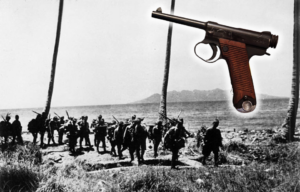
At the beginning of the 20th century, Japan pursued an aggressive campaign of military modernization and expansion as it sought recognition as a major world power. Japanese military planners believed that success on the battlefield would depend not only on the size of their forces but also on providing troops with modern and effective weaponry. Out of this push came the Nambu pistol, which was adopted as a standard sidearm by Japanese soldiers during the Second Sino-Japanese War and remained widely used throughout World War II.
Designing the Nambu pistol

The Type 26, developed by the Koishikawa Arsenal, was the first modern revolver to be put into service by the Japanese Imperial Army, seeing extensive use during the First Sino-Japanese War. At the turn of the 20th century, semi-automatic pistols were becoming more prominent. Kijirō Nambu, a soldier and firearms designer, began work on a new gun, which used the locking mechanism featured on the German Mauser C96.
The initial model of the Nambu pistol was called the “Type A,” and two versions were created. The first, nicknamed the “Grandpa” Nambu by collectors, resembled a Luger and was only manufactured between 1903-06. The second, dubbed the “Papa” Nambu, saw a couple of modifications, including the enlargement of the trigger guard and the ability to have it fitted with a stock.
Development of the Type B Nambu pistol

During its production, only about 7,000 Type A pistols were manufactured. After recognizing the design’s shortcomings, the Imperial Japanese Army developed an improved version known as the Type B, with roughly 6,000 units eventually produced. Compared with its predecessor, the Type B was more compact and incorporated an aluminum magazine as well as a firing pin with revised diameters.
The Type 14 model was put into mass production

Work on the Type 14 model of the Nambu pistol began in 1926. It was named as such because it went into production during the 14th year of the Taishō period. A recoil-spring, semi-automatic weapon, it fired the 8 x 22 mm Nambu round, which was also used by the Type 100 submachine gun. The barrel’s design was such that only this type of ammunition could be used, making it weaker than similar handguns.
The goal was to produce a weapon that was similar to the Type B, but at a much lower cost. When all was said and done, the new Nambu pistol came in at just 78 yen, making it more accessible to military officers.
The Type 14 went into production and was soon adopted by the Imperial Japanese Army. Over the course of its production period, an estimated 400,000 units were manufactured. However, it’s difficult to ascertain the actual number, as soldiers would often throw away or destroy their guns upon defeat, rather than have them fall into enemy hands.
Use of the Nambu pistol in major conflicts

An estimated 4.1 million Japanese soldiers participated in the Second Sino-Japanese War, with an additional six million engaging in the Pacific Theater during World War II. Throughout this period, the Type 14 Nambu became as the main service pistol, widely adopted by servicemen.
However, cost-cutting measures compromised the Type 14’s reliability compared to its predecessors. One notable flaw was the magazine, which proved challenging to remove when wet or dirty, making it difficult to reload. To address this, the magazine catch was eliminated. Another concern centered around the trigger guard, which was too small to accommodate heavy gloves, a bigger problem in colder climates.
A popular collector’s item

More from us: The Mosin-Nagant Has Seen Over a Century of Service