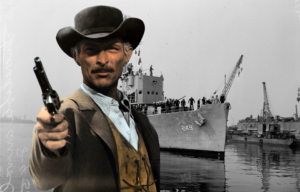
Before Lee Van Cleef became an iconic presence in Hollywood Westerns, recognized for his piercing stare and commanding demeanor, he had already experienced the realities of military service during World War II. Serving in the U.S. Navy, he worked aboard minesweepers and submarine chasers, carrying out missions in hazardous waters where calm decision-making and unwavering focus could mean the difference between life and death.
Those years in uniform played a major role in shaping the hardened confidence and quiet authority that later distinguished his performances on screen. Long before moviegoers associated him with memorable Western characters, Van Cleef had already cultivated the discipline, resilience, and restrained intensity that would define his enduring career in cinema.
Lee Van Cleef enlisted in the US Navy

Clarence LeRoy “Lee” Van Cleef, Jr. was born on January 9, 1925, in Somerville, New Jersey. After graduating high school early, he intended to enlist in the U.S. Navy. By that time, the United States was fully involved in the Second World War, and Van Cleef was eager to do his part.
In late 1942, Van Cleef completed basic training and went on to attend Sonarman School. Upon finishing this training, he was assigned the rank of sonarman third class and stationed aboard the submarine chaser USS SC-681. Over the course of a 10-month deployment, the ship patrolled the Caribbean, tasked with hunting down German U-boats in the region.
When Van Cleef was ordered to leave the SC-681 to attend additional training at Fleet Sound School in Key West, Florida, he had been promoted to sonarman second class.
Participating in the Allied landings of France

Once he graduated from Fleet Sound School, Lee Van Cleef was assigned to Savannah, Georgia, where he became part of the pre-commissioning crew for the USS Incredible (AM-249), a minesweeper constructed for hazardous coastal missions. Following a shakedown voyage along the U.S. East Coast and into the Caribbean, the vessel sailed to Europe to support the Allied invasion of southern France.
Operations in the Pacific Theater

Lee Van Cleef decided to give acting a try

Following his military service, Lee Van Cleef returned to New Jersey, where he participated in community theater. He worked his way up and eventually found himself in Manhattan, at the behest of a talent scout. His big break came in the 1952 Western, High Noon, starring Gary Cooper. Van Cleef had actually been offered a more prominent role if he’d gotten a nose job, but he declined and, instead, played the villainous Jack Colby.
His role in High Noon greatly influenced Van Cleef’s career trajectory. Over the following decade, he appeared in many Westerns, usually playing the villain, and noir films. He also made a number of television appearances, acting on such shows as Annie Oakley (1954-57), The Rifleman (1958-63) and Gunsmoke (1955-75). Similar to his film career, the majority of these small screen productions were in the American Western genre.
Becoming a sought-after actor

In 1965, Sergio Leone cast Lee Van Cleef as the villain in For a Few Dollars More. His work opposite Clint Eastwood was so good that he was subsequently cast as the villain in The Good, the Bad and the Ugly (1966).
It was the latter role that made Van Cleef a star and much sought-after actor. He continued to appear in movies directed by Leone throughout the remainder of the 1960s, and also starred in such features as Death Rides a Horse (1967), Day of Anger (1967) and Sabata (1969).
While Van Cleef arguably made his biggest films in the 1960s, he kept on acting throughout the 1970s and ’80s. Some of his most notable movie appearances during this time included as Police Commissioner Bob Hauk in Escape from New York (1981) and as US Marshal Chris Adams in The Magnificent Seven Ride! (1972). He even appeared alongside famed action star Chuck Norris in 1980’s The Octagon.
Lee Van Cleef worked up until his death

Lee Van Cleef continued working up until his death, appearing in 90 films and receiving 109 television credits. On December 16, 1989, the famed actor suffered a heart attack at his California home and passed away. He’d been diagnosed with heart disease in the late 1970s and had since had a pacemaker installed. In the autopsy report, throat cancer was listed as a secondary cause.
More from us: Tom Hanks Fired An Actor from ‘Band of Brothers’ Because He Had ‘Dead Eyes’
In recognition of his impact on the Western genre, many of those who attended Van Cleef’s funeral wore period-authentic clothing and cowboy hats. He was buried at Forest Lawn Memorial Park Cemetery in Hollywood Hills, California.