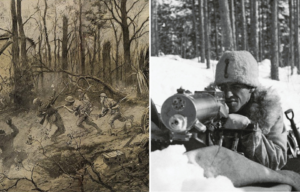
Battle of Belleau Wood
It’s very common for films to be made about World War II. Movies about the Vietnam War were also quite common during the 1980s. There are not, however, many movies about the First World War. The Battle of Belleau Wood was fought in France in 1918, and saw the Germans take on French, American and British soldiers. It is also considered the battle where the US Marine Corps truly came into its own. As such, it would make for a great film.

All great movies have a likable hero, and Marine Dan Daly makes for a great one. Daly, a legendary member of the US military, is treated as almost a mythical figure within the Marine Corps. It was during the Battle of Belleau Wood that he uttered the famous line, “Come on, you sons of *******, do you want to live forever,” while leading a charge.
As well, the Allied victory was the first major engagement the US Army fought during WWI. Despite their attempts to gain ground during the spring offensive, the tired German soldiers were no match for the Americans, who continued to eagerly showcase their skills after entering the conflict in 1917.
This one should be green-lit immediately.
The Winter War
At the end of the 1930s, Joseph Stalin was determined to extend Soviet influence and territory. Commanding a vast military force equipped with thousands of tanks, he viewed Finland as a vulnerable prize. Stories of unlikely victories have always fascinated people, and this historic clash between a smaller nation and a powerful enemy is a prime example.
When Russia invaded Finland in late 1939, the campaign quickly proved to be a costly mistake. While Soviet troops were no strangers to harsh winter conditions, the Finns possessed a deep familiarity with their homeland and used that advantage effectively. Moving quickly across the snowy wilderness on skis, Finnish soldiers carried out guerrilla-style attacks and could easily identify Soviet units that stood out against the bright white landscape.

Finland’s success in the skies was just as impressive. Although its Air Force was relatively small, the country upheld strict standards when choosing pilots. Throughout the war, Finnish aviators downed far more Soviet aircraft than they lost themselves.
The snow-covered Finnish countryside would also serve as a stunning and highly cinematic setting for the story.
Battle of Carrhae

Crassus’s ambition knew no bounds, leading him to launch a campaign against Parthia in pursuit of wealth and renown. The venture ended in disaster. During a subsequent peace negotiation the following day, the Parthians executed him in a gruesome display—pouring molten gold into his mouth as a symbolic punishment for his insatiable greed.
This infamous death reportedly inspired a strikingly similar moment in the first season of HBO’s Game of Thrones, where the show mirrored history’s grim lesson on avarice and hubris.
Battle of Yorktown
Despite the clear importance to the history of the country, there have been very few movies made about the Revolutionary War. Thanks to the wild success of the Broadway musical Hamilton, however, now would be as good a time as any to shine a light on the time period. A great place to start would be with a movie about the Battle of Yorktown.

The Americans won the battle, thanks to a collaboration between George Washington and the Marquis de Lafayette. After three weeks of fighting, the movie would certainly have a happy ending. The Battle of Yorktown ended with the surrender of the British forces, leading to the Treaty of Paris and American independence.
Battle of Longewala
Although the 1997 Border introduced many Indian audiences to the Battle of Longewala, the confrontation merits far wider international recognition. The battle stands out not only for the remarkable courage displayed by a heavily outnumbered force facing a much larger enemy, but also for the moments of humanity, resilience, and even humor that emerged amid the chaos of combat—elements that are often absent from more conventional portrayals of war.
