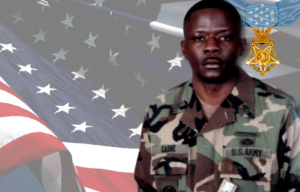
Sergeant First Class Alwyn Cashe earned the Medal of Honor—the U.S. Army’s highest award for bravery—through remarkable courage under devastating circumstances. While serving in Iraq, his Bradley Fighting Vehicle was struck by an improvised explosive device, causing fuel to cover his body and burst into flames. Even while severely burned and facing extreme danger, Cashe focused not on his own survival, but on saving the soldiers around him.
Ignoring his injuries, he repeatedly entered the burning vehicle to rescue his comrades. He first pulled the driver to safety, then continued returning for other trapped soldiers as the flames spread across his body. Through his selfless determination, several lives were saved, though the injuries he sustained would eventually take his own life.
For weeks, Cashe fought for survival in critical condition before ultimately succumbing to his wounds. His extraordinary actions became a lasting symbol of sacrifice, courage, and devotion to others above self. Today, his memory lives on as one of the clearest examples of heroism among America’s most honored service members.
Military service prior to the War in Iraq
After graduating from high school, Alwyn Cashe joined the U.S. Army in 1989 and quickly began building a distinguished military career. One of his earliest assignments took him to Korea for a two-year deployment, followed by service during the Gulf War. He later spent three years at Fort Lewis in Washington before returning to Korea in 1993 for another year of duty as an infantry soldier. As his experience and leadership abilities grew, Cashe became a squad leader at Fort Hood, Texas, and completed an additional two-year assignment in Germany.
Cashe continued advancing professionally in 1998 when he completed Drill Sergeant School. He then dedicated two years at Fort Benning, Georgia, to preparing and mentoring new Army recruits. In 2001, he transitioned to Europe, serving as an operations noncommissioned officer with the 19th Battlefield Coordination Detachment. Later, he assumed leadership of a squad within the 1st Battalion, 18th Infantry Regiment, further strengthening the command skills and dedication that characterized his military service.
Cashe became a platoon sergeant in the 3rd Brigade, 3rd Infantry Division at Fort Benning in April 2004.
Operation Iraqi Freedom
Sergeant First Class Alwyn Cashe served two tours in Iraq, the first during the 2003 invasion and the second during Operation Iraqi Freedom. During his second deployment, he served with A Company, 1st Battalion, 15th Infantry Regiment, 3rd Infantry Division.

On the evening of October 17, 2005, Cashe’s unit set out on a routine clearance patrol, preparing for another convoy that was scheduled to pass through the area the following day. Although a dust storm was sweeping through the region, the mission was intended to be “a standard drive down to the bridge, make sure the route was clear, hang out for a bit, and drive right back,” with the exception that only two of the three Bradley Fighting Vehicles were able to participate.
Cashe’s Bradley was leading the convoy when it hit a roadside IED. The explosion ruptured the vehicle’s fuel cell, spraying those inside with fuel, and damaged the cargo hatch’s opening mechanism. Cashe, who was only lightly injured, managed to crawl out through the gunner’s hatch.
Six soldiers were trapped inside the vehicle, which was quickly consumed by flames. Despite his uniform being soaked in fuel, Cashe rescued the soldiers and removed the body of an Iraqi translator who had been killed in the blast.

During the rescue, Cashe suffered second and third-degree burns to 72 percent of his body. He and the injured were medivaced to a nearby Iraqi military hospital, and he was later transported to Brooke Army Medical Center, Fort Sam Houston, Texas, where he succumbed to his injuries on November 8, 2005.
For his actions, he was nominated for the Silver Star by his battalion commander, Lieutenant General Gary Brito.
Road to the Medal of Honor
The effort to upgrade Sgt. 1st Class Cashe’s Silver Star to the Medal of Honor was initiated by Lt. Gen. Brito, who initially was unaware of the severity of Cashe’s injuries since the witnesses had been evacuated for medical care. Upon gaining a deeper understanding of Cashe’s actions, Brito provided additional statements to the Army to advocate for posthumously awarding him the honor.

The push to upgrade Cashe’s Silver Star started again in October 2019, led by retired Navy SEAL Dan Crenshaw, Stephanie Murphy (D-FL) and former Special Forces officer Michael Waltz. They sent a letter to Secretary of Defense Mark Esper and Army Secretary Ryan McCarthy, urging them to approve the change.
Murphy took additional steps by introducing Bill HR 8276 in the U.S. House of Representatives. This bill removed the five-year time limit for Medal of Honor eligibility and gave the President the authority to award the medal “for acts of valor during Operation Iraqi Freedom.” The House passed the bill with full support on September 22, 2020, and the Senate approved it a little over a month later.
On December 3, 2020, President Donald Trump signed it into law.

On December 16, 2021, Cashe’s widow, Tamara, accepted the Medal of Honor on his behalf from President Joe Biden at a ceremony honoring him and two other service members, Sergeant First Class Christopher Celiz and Master Sergeant Earl Plumlee. He was the seventh soldier from Operation Iraqi Freedom to receive the honor and the first African-American since the Vietnam War.
Speaking at the ceremony, President Biden called him “a soldier’s soldier” and “a man who literally walked through fire for his men.”