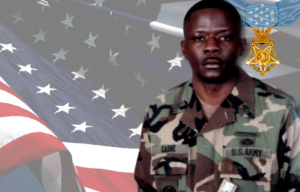
The Medal of Honor stands as the highest recognition for valor in the U.S. Army, a distinction earned by Sergeant First Class Alwyn Cashe through extraordinary acts of courage. After an IED struck his Bradley Fighting Vehicle in Iraq, fuel soaked his uniform and ignited, engulfing him in flames. Despite the intense pain and life-threatening danger, Cashe refused to leave his fellow soldiers behind.
Time and again, he returned to the burning vehicle—rescuing the driver and then pulling other trapped soldiers to safety, even as the fire continued to consume him. His unwavering bravery saved multiple lives before his injuries ultimately proved fatal.
Cashe remained in critical condition for weeks before passing away, but his actions came to represent the highest ideals of selflessness and heroism: placing the lives of others above his own. His legacy endures as a powerful example of courage and sacrifice, forever honored among America’s most distinguished heroes.
Military service prior to the War in Iraq
Alwyn Cashe enlisted in the U.S. Army in 1989, beginning his military career shortly after graduating from high school. Early in his service, he completed a two-year deployment in Korea and later took part in operations during the Gulf War. He then spent three years stationed at Fort Lewis, Washington, before returning to Korea in 1993 for an additional year as an infantryman. Over time, he rose to the position of squad leader at Fort Hood, Texas, and also served a two-year assignment in Germany.
In 1998, Cashe graduated from Drill Sergeant School and spent the next two years training new recruits at Fort Benning, Georgia. By 2001, he had moved into a new role in Europe as an operations noncommissioned officer with the 19th Battlefield Coordination Detachment. He later went on to lead a squad in the 1st Battalion, 18th Infantry Regiment, continuing to build the leadership experience that would define his distinguished career.
Cashe became a platoon sergeant in the 3rd Brigade, 3rd Infantry Division at Fort Benning in April 2004.
Operation Iraqi Freedom
Sergeant First Class Alwyn Cashe served two tours in Iraq, the first during the 2003 invasion and the second during Operation Iraqi Freedom. During his second deployment, he served with A Company, 1st Battalion, 15th Infantry Regiment, 3rd Infantry Division.

On the evening of October 17, 2005, Cashe’s unit set out on a routine clearance patrol, preparing for another convoy that was scheduled to pass through the area the following day. Although a dust storm was sweeping through the region, the mission was intended to be “a standard drive down to the bridge, make sure the route was clear, hang out for a bit, and drive right back,” with the exception that only two of the three Bradley Fighting Vehicles were able to participate.
Cashe’s Bradley was leading the convoy when it hit a roadside IED. The explosion ruptured the vehicle’s fuel cell, spraying those inside with fuel, and damaged the cargo hatch’s opening mechanism. Cashe, who was only lightly injured, managed to crawl out through the gunner’s hatch.
Six soldiers were trapped inside the vehicle, which was quickly consumed by flames. Despite his uniform being soaked in fuel, Cashe rescued the soldiers and removed the body of an Iraqi translator who had been killed in the blast.

During the rescue, Cashe suffered second and third-degree burns to 72 percent of his body. He and the injured were medivaced to a nearby Iraqi military hospital, and he was later transported to Brooke Army Medical Center, Fort Sam Houston, Texas, where he succumbed to his injuries on November 8, 2005.
For his actions, he was nominated for the Silver Star by his battalion commander, Lieutenant General Gary Brito.
Road to the Medal of Honor
The effort to upgrade Sgt. 1st Class Cashe’s Silver Star to the Medal of Honor was initiated by Lt. Gen. Brito, who initially was unaware of the severity of Cashe’s injuries since the witnesses had been evacuated for medical care. Upon gaining a deeper understanding of Cashe’s actions, Brito provided additional statements to the Army to advocate for posthumously awarding him the honor.

The push to upgrade Cashe’s Silver Star started again in October 2019, led by retired Navy SEAL Dan Crenshaw, Stephanie Murphy (D-FL) and former Special Forces officer Michael Waltz. They sent a letter to Secretary of Defense Mark Esper and Army Secretary Ryan McCarthy, urging them to approve the change.
Murphy took additional steps by introducing Bill HR 8276 in the U.S. House of Representatives. This bill removed the five-year time limit for Medal of Honor eligibility and gave the President the authority to award the medal “for acts of valor during Operation Iraqi Freedom.” The House passed the bill with full support on September 22, 2020, and the Senate approved it a little over a month later.
On December 3, 2020, President Donald Trump signed it into law.

On December 16, 2021, Cashe’s widow, Tamara, accepted the Medal of Honor on his behalf from President Joe Biden at a ceremony honoring him and two other service members, Sergeant First Class Christopher Celiz and Master Sergeant Earl Plumlee. He was the seventh soldier from Operation Iraqi Freedom to receive the honor and the first African-American since the Vietnam War.
Speaking at the ceremony, President Biden called him “a soldier’s soldier” and “a man who literally walked through fire for his men.”