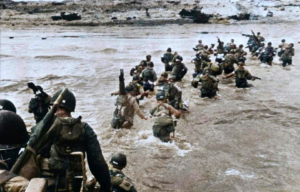

The D-Day landings, which significantly influenced the outcome of the Second World War, involved a massive force of well over 100,000 Allied troops. Of the approximately 160,000 soldiers who participated, 83,000 were British and Canadian, while 73,000 were American. In contrast, the German forces consisted of about 50,000 troops.
As Operation Overlord, or the Battle of Normandy, progressed, more than two million Allied soldiers contributed to the liberation of France.
Operation Bodyguard came before Operation Overlord

In the months leading up to D-Day, the Allies put extensive effort into planning measures designed to increase the invasion’s chances of success, chief among them a large-scale deception effort known as Operation Bodyguard. Its purpose was to mislead German commanders into believing the primary Allied assault would strike Pas-de-Calais rather than the coast of Normandy. This ruse succeeded in drawing German troops and resources away from the actual landing areas, weakening their defenses when the invasion began.
A notable element of this deception was Operation Copperhead. As part of the scheme, the Allies employed a man who closely resembled British General Bernard Montgomery to appear publicly in various Allied-controlled locations. These staged appearances were meant to suggest that Montgomery was not involved in planning the invasion, casting doubt on Normandy as the target. The double’s movements also reinforced other false intelligence, helping lend credibility to the broader Allied misdirection campaign.
D-Day was initially slated to occur on June 5, 1944

While June 6, 1944, is etched in history, D-Day wasn’t initially planned for that date. The landings were originally scheduled for June 5, but were delayed by 24 hours after Irish postmistress Maureen Flavin Sweeney reported an approaching storm.
Supreme Allied Commander Gen. Dwight D. Eisenhower made the critical decision to postpone the operation. This choice not only contributed to the mission’s success, but also saved countless Allied lives.
Thousands of ships and landing craft were involved in D-Day

D-Day was centered around amphibious landings, which means the troops needed vessels to get across the English Channel.
It’s reported that nearly 7,000 ships and landing craft were used to ensure the success of the landings. Of that total, 80 percent were supplied by the British and 16.5 percent came from the United States.
What does the ‘D’ in D-Day stand for?

For nearly 80 years since the Normandy landings, people have wondered: what does the “D” in D-Day actually mean? Surprisingly, the answer isn’t very exciting.
The “D” simply stands for “Day,” so “D-Day” literally means “Day-Day“. Not exactly the most natural-sounding name, right?
A fatal live-fire rehearsal

A lot of preparation went into the D-Day landings, much of which involved training troops for what they could expect upon arriving in German-occupied France. Several coastal villages were taken over and numerous rehearsals were held.
One practice run was the fatal Exercise Tiger, which resulted in the deaths of over 700 Allied troops. Many of the casualties were killed during a live-fire exercise, while many others perished during what became known as the Battle of the Lyme, during which E-boats operated by the Kriegsmarine attacked Tank Landing Ships (LST) in the English Channel.
What obstacles did the Allies face on the landing beaches?

No one wanted to wake the Führer…

As previously noted, the Germans fully expected an Allied invasion—but anticipation didn’t necessarily mean readiness. One glaring example of this failure? Failing to wake the Führer from his slumber.
Sixteen soldiers received the Medal of Honor

Sixteen American servicemen received the Medal of Honor for extraordinary acts of bravery during the D-Day invasion and the fierce battles that followed in Normandy. Of these heroes, nine were recognized posthumously for making the ultimate sacrifice. Four medals were awarded specifically for courage displayed on June 6, 1944: Pvt. Carlton W. Barrett, First Lt. Jimmie W. Monteith, Jr., Technician Fifth Grade John J. Pinder, Jr., and Brigadier General Theodore Roosevelt, Jr.
Among them, Roosevelt’s story stands out not only for his gallantry but also because he was the eldest son of President Theodore Roosevelt. On D-Day, he took charge at Utah Beach, moving fearlessly among the landing troops while under intense enemy fire. His decisive leadership helped organize the chaotic beachhead and secure a crucial foothold for the Allied push into France—contributions that were instrumental to the operation’s overall success.
Lt. Herbert Denham ‘Den’ Brotheridge

Have you ever wondered who the first Allied casualty of the D-Day landings was? According to reports, it was Lt. Herbert Denham “Den” Brotheridge, an officer in the British Army.
Serving with the 2nd Battalion, Oxfordshire and Buckinghamshire Light Infantry, he was killed while taking part in Operation Tonga, a mission undertaken by the British 6th Airborne Division to take control of and destroy the Merville Gun Battery. The site was approximately eight miles from Sword Beach.
While taking on German machine gunners, Brotheridge was hit in the back of the neck by enemy fire. While attempts were made to render medical aid, he perished.
Playing the bagpipes

Several notable individuals participated in the D-Day landings, but none were as unique as “Piper Bill” Millin, whose music led British Commandos from Sword Beach to Pegasus Bridge.
Millin played the bagpipes under Simon Fraser, 15th Lord Lovat, who’d been appointed the commander of the 1st Special Service Brigade (1st SSB). Under a hail of enemy and friendly fire, the former played his music, walking the entire length of Sword Beach three times, before moving toward the key bridge area.
How did he survive without a weapon, you ask? Well, according to a German soldier who spoke to Millin decades later, the enemy forces thought he was “off your head” – they didn’t want to waste their bullets on him!
Outnumbering the Luftwaffe 30:1

Approximately 11,000 Allied aircraft participated in the D-Day landings, a sizeable number, given the dwindling numbers of the Luftwaffe.
According to the BBC, the Allies outnumbered the Germans 30-to-one in the air. Given this, the latter failed to down any of the former’s aircraft in air-to-air combat.
How many casualties were suffered?

On June 6, 1944, alone, several thousand casualties were suffered by both sides. The Allies inflicted between 4,000 and 9,000 on the Germans, while they themselves experienced just over 12,000. According to the National WWII Museum, the breakdown for the Allies was:
- United States – 8,230
- United Kingdom – 2,700
- Canada – 1,074
Much of the footage was lost in the English Channel

Have you ever wondered why so little film footage exists of the D-Day landings? One surprising explanation is that much of it was accidentally dumped in the English Channel—a story often cited in accounts of the invasion.
Renowned American director John Ford had been assigned to document the assault on Omaha Beach, working alongside the U.S. Coast Guard. After filming, most of the reels were packed into a duffel bag for transport to Britain. During the journey, however, the bag was reportedly dropped overboard by Major W.A. Ullman, a junior officer, sending the footage to the bottom of the sea.