History of Swiss neutrality

Switzerland’s neutral stance during World War II was not a new approach. The country has been committed to neutrality since the 16th century, following the Battle of Marignano. After the Swiss Army’s defeat by the French in September 1515, Switzerland intentionally decided to avoid future conflicts in favor of self-preservation.
Despite this long-standing commitment to neutrality, Switzerland encountered challenges to its position over the centuries, mainly due to the actions of other nations.
In 1815, Switzerland officially declared its neutrality at the Congress of Vienna and 1815 stuck to this policy during World War I by refraining from direct military engagement. Nonetheless, Switzerland still offered refuge to displaced individuals and mobilized its military forces. Tensions within the country also arose among its French-, Italian-, and German-speaking communities.
Following World War I, the victorious powers established the League of Nations, which recognized Switzerland’s neutrality and chose Geneva as its headquarters.
A promise from Germany, to Switzerland

Switzerland’s neutrality appeared secure during the rapid ascent of the Führer, who guaranteed that their status would be honored. In a meeting in February 1937, he even assured Swiss official Edmund Schulthess that Germany would not invade the country. Yet, these assurances proved as stable as a house of cards. Throughout the war, Germany quickly took control of neighboring nations- Denmark, Luxembourg, the Netherlands, Poland, Norway and Belgium were all occupied.
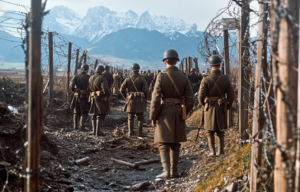
Fully aware of Germany’s brutal strategies, Switzerland chose to proceed with caution and mobilized its military. At its height, the Swiss force grew to an impressive 850,000 soldiers, all under the leadership of Henri Guisan, a distinguished veteran with a remarkable career in the Swiss Armed Forces.
Guisan led the National Redoubt strategy, a defensive plan that called for the deployment of three mountain brigades and eight infantry divisions. These troops underwent intense training that mirrored the harsh battles occurring across Europe. The strategy, in the event of an invasion, was for the Swiss government to relocate to the Alps, thereby safeguarding both territory and political authority.
The planning of Operation Tannenbaum

The Führer, with disdain, declared to Italian Prime Minister Benito Mussolini, “Switzerland possesses the most disgusting and miserable people and political system. The Swiss are the mortal enemies of the new Germany.”
The invasion plan, named Operation Tannenbaum, would have seen a division of the Wehrmacht, stationed in Central France with two million soldiers, advancing into Switzerland. The strategy also included Italian forces. German troops were assigned to seize Geneva and Lucerne, while the Italian Army would invade through the Alps, aiming to split up Switzerland between the two nations.
Despite the combined military might of Italy and Germany, which could have easily overwhelmed Switzerland, Operation Tannenbaum was never executed, for reasons that remain unclear.
Why didn’t the Germans move forward with Operation Tannenbaum?

After Germany’s defeat, historians and military analysts debated why Operation Tannenbaum—the proposed invasion of Switzerland—never progressed beyond planning. Several compelling reasons have come to light.
Foremost was Switzerland’s remarkable state of preparedness. Though its military was far smaller than Germany’s, the Swiss invested heavily in modern weaponry and established an extensive network of fortifications. Coupled with the challenging Alpine terrain and the scarcity of navigable routes, any invasion would have been a punishing, high-casualty endeavor.
Equally influential were the strategic benefits Germany gained from Swiss neutrality. Swiss banks served as discreet repositories for looted Nazi gold, while the country’s central location offered a potential refuge or escape route for German officials if the war turned against them.
Switzerland remains neutral to this day

Despite the challenges, Switzerland managed to stay neutral during the whole of the Second World War. Since then, the country has largely stayed out of major conflicts, with the exception of the War in Afghanistan. This was the first time Switzerland engaged in combat since 1815. Additionally, during the War in Iraq, Swiss officials allowed American forces to use Swiss airspace for surveillance missions.
In 2022, then-President Ignazio Cassis outlined Switzerland’s position, stating that the country’s values consist of “no participation in wars; international cooperation but no membership in any military alliance; no provision of troops or weapons to warring parties and no granting of transition rights.”