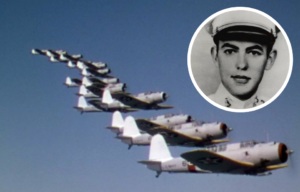
The Battle of Midway is often considered one of the most consequential naval battles ever fought. In June 1942, three American aircraft carriers confronted a Japanese carrier force of four ships, including the same carriers that had participated in the Attack on Pearl Harbor roughly six months earlier. Although courage and sacrifice were displayed by personnel on both sides, only a single Medal of Honor was awarded by the United States for actions during the battle, and it was presented to Richard E. Fleming.
Among the officers who distinguished themselves during the fighting was Max Leslie, commander of Bombing Squadron 3. Despite discovering that his aircraft no longer carried bombs, Leslie continued to lead his squadron in an aggressive attack on the Japanese fleet. His leadership helped support the assaults that resulted in the loss of two enemy carriers. In recognition of his conduct during the battle, he received the Navy Cross.
Richard E. Fleming

Richard E. Fleming was born in Saint Paul on November 2, 1917. Excelling in school from a young age, he graduated as valedictorian of Saint Thomas Military Academy in 1935. He then attended the University of Minnesota, serving as president of the Delta Kappa Epsilon fraternity before earning his degree in 1939.
After completing college, Fleming entered the U.S. Marine Corps Reserve and volunteered for pilot training. He again distinguished himself by graduating first in his class in 1940. Over the following two years, he received a series of promotions, attaining the rank of captain by mid-1942.
The Battle of Midway
After the successful attack on Pearl Harbor on December 7th, the Japanese aimed to continue this success by knocking out the U.S. carriers that were still a major threat. The carrier threat had been exacerbated in April of 1942 when the U.S. launched the Doolittle Raid from the USS Hornet aircraft carrier. Sixteen B-25 Mitchell bombers were modified to take off from a carrier and have enough fuel to reach the Japanese mainland and strike targets such as Tokyo and other key cities.

The attacks caused little damage, but were an enormous blow to Japanese morale, who incorrectly believed they were invulnerable to U.S. strikes. Meanwhile, this was a much-needed boost to U.S. morale.
Admiral Isoroku Yamamoto commanded the battle. His goal was to lure the U.S. carriers into battle by attacking Midway Atoll, where he would then decimate their forces and capture the atoll. With the U.S. forces destroyed and the atoll captured, the Japanese would have a significant extension on their area of operations in the Pacific. If these goals were achieved, the Japanese would then begin negotiating the United States’ surrender.
The Japanese planning for the battle was heavily dependent on incorrect intelligence, and to make this worse, U.S. codebreakers had intercepted communications and already knew the attack was coming.
The U.S. and Japan clashed in battle, which resulted in a crippling Japanese defeat. Four Japanese carriers and 3,000 men were lost to one U.S. carrier and just under 400 men. The U.S. victory is considered to be one of the most impressive and important naval victories in history.
Fleming’s heroic acts during the battle
On June 5, 1942, the second day of the Battle of Midway, Fleming was the Flight Officer of Marine Scout Bombing Squadron 241, taking command after the previous commander had been shot down the day before. The squadron, nicknamed the “Sons of Satan,” flew 16 Douglas SBD-2 Dauntless and 11 Vought SB2U-3 Vindicator dive bombers.

He led his men on an attack against the Japanese heavy cruiser Mikuma. During the attack, he dropped out of formation and dove through a hail of anti-aircraft fire to a height of just 400 feet to guarantee a hit on the vessel. His aircraft was hit and caught ablaze, but he continued on, releasing his ordnance.
Fleming’s aircraft subsequently crashed into the sea, killing him.
For “extraordinary heroism and conspicuous intrepidity above and beyond the call of duty as Flight Officer,” Fleming was posthumously awarded the Medal of Honor, the nation’s highest award.
President Franklin Roosevelt presented the award to Fleming’s mother on November 24, 1942.

More from us: MoH Recipient Singlehandedly Destroyed A Tiger Tank And Captured 17 Germans
His Medal of Honor citation said: “His dauntless perseverance and unyielding devotion to duty were in keeping with the highest traditions of the United States Naval Service.”
Just over a year after his death, on September 18, 1943, the U.S. Navy commissioned the USS Fleming, an Evarts-class destroyer escort, in his honor.