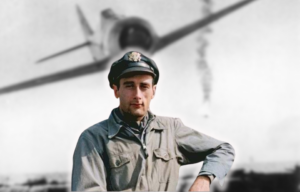

Born in New York, Bruce Carr was just 15 years old when the Second World War broke out in 1939. Motivated by the events of that year, the teenager made a firm commitment to master the art of flying.
Jump ahead three years to September 3, 1942, and Carr, now 18, enthusiastically enlisted in the US Army Air Forces. Using his prior aviation experience, he joined the service’s accelerated training program, ascending into the skies aboard the Curtiss P-40 Warhawk.
On August 30, 1943, Carr attained the rank of flight officer, amassing an impressive 240 flight hours. His expertise extended to specialized training, enabling him to pilot both the North American P-51 Mustang and A-36 Apache. The former, in particular, held a special place in his heart, earning the endearing nickname, Angels’ Playmate.
He didn’t get credit for his first aerial victory

In 1944, Carr was stationed in England with the 380th Fighter Squadron, 363rd Fighter Group, Ninth Air Force at RAF Rivenhall. His first major combat achievement came after an intense chase and exchange of gunfire, leading to the downing of a Messerschmitt Bf 109. However, this victory wasn’t officially recognized because it didn’t meet the strict criteria for a confirmed kill.
His bold and assertive flying style made him stand out as a unique pilot, though his superiors often criticized him for being “overaggressive.” As a result, he was reassigned to the 353rd Squadron, 354th Fighter Group, at RAF Lashenden.
A trip to Germany

On November 2, 1944, during a daring mission over Czechoslovakia, Bruce Carr lost his beloved P-51D while leading a low-level strike on a German airfield. After his aircraft malfunctioned, he was forced to eject and found himself deep behind enemy lines.
For several days, Carr evaded capture, using his quick thinking and resourcefulness to remain hidden. However, after enduring prolonged periods without food or water, he grew weak and considered surrendering. Spotting a nearby German airfield, he decided it was his best chance to give himself up.
But fate had another plan. As Carr approached the airfield, he saw a German crew preparing a Focke-Wulf Fw 190 for takeoff. When the crew stepped away from the aircraft, Carr seized the opportunity—slipping onto the plane and quietly taking control.
Traveling home

Bruce Carr sticks the landing

Bickel had just one question for the pilot: “Carr, where in the hell have you been, and what have you been doing now?”
Bruce Carr’s service in Vietnam and Korea

Following World War II, Bruce Carr continued his service with the US Army Air Forces as it became the US Air Force. Initially, he was tasked with piloting the Lockheed F-80 Shooting Star as a member of the Acrojets, America’s inaugural jet-powered aerobatic demonstration team. Their base of operations was at Williams Air Force Base, Arizona.
During the Korean War, now-Maj. Carr flew an impressive 57 missions with the 336th Fighter-Interceptor Squadron, before assuming command of the squadron from January 1955 to August ’56.
Carr flew 286 combat missions in Vietnam

After rising to the rank of colonel, Bruce W. Carr continued his military career in Vietnam, flying with the 31st Tactical Fighter Wing out of Tuy Hoa Air Base. There, he focused on close air support operations and completed an astounding 286 combat missions in the North American F-100 Super Sabre.
More from us: The American Air Ace Shot Down By Friendly Fire During the Battle of the Bulge
Carr retired from the Air Force in 1973, closing out a distinguished career that spanned three major conflicts. His valor and dedication earned him an array of honors, including the Distinguished Service Cross, the Legion of Merit, the Silver Star, four Distinguished Flying Crosses, and 31 Air Medals.
In 1998, Carr died of prostate cancer and was laid to rest with full honors at Arlington National Cemetery, a fitting tribute to a pilot whose service and daring left a lasting mark on U.S. military history.