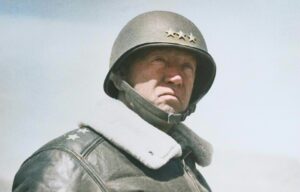
General George S. Patton remains one of the most formidable personalities in American military history. Known by the moniker “Old Blood and Guts,” he gained renown for his bold command style and exceptional battlefield instincts, playing a decisive role in shaping U.S. strategy during World War II and helping drive the Allied advance to victory. His tireless drive and habit of leading from the front inspired troops to push beyond their limits and cemented his reputation among those who served under him.
What has allowed Patton’s reputation to endure long after the war ended? A closer look at the key moments and accomplishments of his career reveals why he is still regarded as one of the nation’s most iconic and influential commanders.
George Patton was destined for the military
Before we can go into why George Patton is such a large part of US military legend and folklore, an overview of his service is required. From a young age, he was interested in serving his country, attending both the Virginia Military Institute and the US Military Academy West Point, from which he graduated 46 out of 103 cadets.

His first taste of combat was during the Pancho Villa Expedition – now known as the Mexican Expedition – of 1916, and he later fought for the American Expeditionary Forces during World War I. Not only did he help build the newly-formed US Tank Corps, he commanded troops, most notably during the Battle of Saint-Mihiel and the Meuse-Argonne Offensive.
When the US entered World War II following the Japanese attack on Pearl Harbor, Patton was given command of the 2nd Armored Division. He was then placed in control of the US Seventh Army in the Mediterranean Theater. He was involved in the invasion of Casablanca during Operation Torch and, later, the invasion of Sicily. It was during these two missions that he established himself as one of the Allied forces’ best commanders.
In the lead up to the D-Day landings, Patton was given a key role in Operation Fortitude, the Allied deception plan to mislead the German High Command. He was also given command of the US Third Army, which he led through the Allied invasion of France. During the Battle of the Bulge, his men relieved American troops at Bastogne, and embarked on a charge across the Rhine and into Germany, capturing 10,000 square miles.
Patton passed away on December 21, 1945, after suffering injuries from a car accident while stationed in Germany.
George Patton had an incredible ability to inspire his men
General George Patton was a controversial figure during the war. His powerful and passionate speeches inspired his troops, but they also made some high-ranking Allied commanders uneasy. Despite this, Patton—an enduring symbol of the American general—remained focused on what mattered most: preparing his soldiers for battle, a task he excelled at.
Patton’s men didn’t just respect his belief that loyalty was more important than intelligence; they fully embraced his aggressive philosophy of battle: “We shall attack and attack until we are exhausted, and then we shall attack again.”

During World War II, Patton became known for his speeches, especially the one he gave to the Third Army before the D-Day invasion. Historians regard it as one of the greatest motivational speeches ever, as it filled his troops with unwavering determination, inspiring them to face their duty with courage and charge into battle without hesitation.
He led by example… From the front!
One of George Patton’s primarily philosophies when it came to leadership was to lead by example – and that’s exactly what he did while serving in Europe during WWII. He always led his men into battle, exemplifying the values and determination he expected from them.
As author Alan Axelrod once wrote, “[Patton’s] message was never we must succeed but always we will succeed.” This inspired many military officers who came after him and influenced US strategy following his death.

Martin Blumenson, historian and author of Patton: The Man Behind the Legend, 1885-1945, said it best:
“Patton epitomized the fighting soldier in World War II. He exercised unique leadership by his ability to obtain the utmost – some would say more than the maximum – response from American combat troops. Through his charisma, exemplified by a flamboyant and well-publicized image, he stimulated, better than any other high-ranking U.S. army commander, American troops to an aggressive desire to close with and destroy the enemy.
“He personified the offensive spirit, the ruthless drive, and the will for victory in battle.”
He personally purchased supplies for his men

Following the strike on Pearl Harbor that drew the United States into World War II, the armed forces scrambled to prepare for a global fight. Commanding the 2nd Armored Division, General George Patton refused to allow bureaucratic delays to undermine combat readiness. Taking an unorthodox approach, he sidestepped the military supply system and ordered needed equipment straight from the Sears Roebuck catalog, ensuring his soldiers were properly outfitted and able to train and operate at full capability.
George Patton helped develop modern tank warfare
George Patton played a pivotal role in the development of America’s Tank Corps during World War I. Fascinated by this new form of warfare, he immersed himself in every detail—collaborating with engineers on mechanics and maintenance, refining battlefield tactics, and observing firsthand the British Army’s groundbreaking tank offensive at the Battle of Cambrai in 1917.
This dedication led him to establish the Light Tank School for the American Expeditionary Forces in Langres, France, where he trained soldiers in the art of armored combat. Patton’s leadership was soon tested at the Battle of Saint-Mihiel, where U.S. tanks rolled into combat for the first time. The triumph not only marked a key victory over German forces but also cemented Patton’s reputation as an innovative commander with a clear vision for the future of mechanized warfare.

Following the First World War, Patton was placed in charge of a cavalry squadron, yet his vision was firmly set on the future of armored warfare. He pushed for replacing traditional horse-mounted units with tanks, arguing that their speed and power could replicate—and even surpass—the shock value once delivered by cavalry charges. To aid this shift, he authored his own manual on tank operations, offering clear guidance for the Army’s modernization.
By the time of World War II, Patton had become inseparable from the very concept of tank warfare, famously directing his men from inside a tank and showcasing the bold, aggressive tactics that defined his command style. His innovations left such a mark on military doctrine that, after his passing, multiple tanks were named for him after his death.
The first was the M46 Patton, an improved version of the M26 Pershing equipped with a stronger engine, upgraded transmission, and a new main gun. It made its combat debut during the Korean War, where it successfully countered the North Korean T-34s. Its successor, the M47 Patton, featured a redesigned turret and quickly became one of the most widely deployed main battle tanks, serving not only the U.S. Army and Marine Corps but also allied forces across NATO and SEATO.
More from us: Paul Tibbets Dropped the Atomic Bomb on Hiroshima and Was Given No Funeral or Gravestone
The M48 Patton marked the first American tank built entirely from scratch rather than adapted from earlier models. Building on the lessons of the M47, it offered stronger armor protection, better fuel economy, and greater mobility. Widely deployed during the Vietnam War, it was primarily used in infantry support roles and remained in service until the M60 took its place. Though not officially designated as a “Patton” tank, the M48 became a cornerstone of America’s armored forces during the Cold War.
One of its standout features was the use of explosive reactive armor, which gave it improved resilience against modern anti-tank weapons. This advancement helped the M48 prove its worth in several major conflicts, including the 1973 Yom Kippur War, the U.S. invasion of Grenada in 1983 (Operation Urgent Fury), and even the Gulf War decades later. Its long service life and adaptability ensured that the M48 left an enduring imprint on U.S. and allied military operations worldwide.