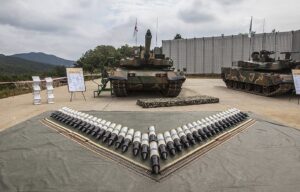
Perched just south of the heavily fortified Demilitarized Zone (DMZ), South Korea remains in a state of constant vigilance, acutely aware of the unpredictable threats posed by the regime to the north. Persistent provocations have driven Seoul to prioritize advanced defense capabilities, focusing on cutting-edge technology, automation, and next-generation warfare systems.
At the heart of this modernization effort stands the K2 Black Panther—a world-class main battle tank considered among the most advanced ever built. Engineered to meet the challenges of 21st-century combat, the K2 functions as both a powerful defensive shield and an offensive spearhead, embodying South Korea’s steadfast commitment to protecting its sovereignty and maintaining regional stability.
Design and development of the K2 Black Panther

Throughout much of the Cold War and the decades that followed, South Korea depended heavily on NATO allies and U.S.-supplied M48 Patton tanks. Once celebrated as state-of-the-art armor, these tanks had grown increasingly outdated by the late 20th century. When the United States retired the Patton in 1987, Seoul faced growing pressure to develop a modern replacement capable of keeping pace with evolving battlefield requirements.
To address this need, South Korea launched an ambitious domestic tank development program between 2003 and 2007, producing five prototype models. Following extensive testing and evaluation, a single design was selected and greenlit for full-scale production by the Defense Acquisition Program Administration (DAPA). However, the initiative encountered significant setbacks—persistent mechanical problems, particularly involving the powertrain and transmission, delayed the tank’s deployment and postponed its entry into active service.
Mass production of the K2 Black Panther

Beginning in 2013, the K2 Black Panther tank was manufactured with German-made MTU power plants to address persistent transmission issues and concerns about the engine’s reliability and durability. By 2014, these tanks were fully combat-ready and started to appear on the battlefield.
In December 2014, production of the K2 shifted to the South Korean company Hyundai Rotem. This transition came with a big cost, as each unit was priced at $8.5 million, ranking it among the most expensive tanks currently in active service.
Impressive defensive capabilities

The K2 Black Panther isn’t just a tank—it’s a battlefield juggernaut designed to dominate nearly any threat. Its core firepower comes from the CN08 120mm smoothbore gun, capable of firing 10 high-velocity rounds per minute with deadly precision. Complementing it are two machine guns—a 7.62mm coaxial and a 12.7mm K6 heavy machine gun—ready to neutralize infantry and light vehicles alike.
What truly sets the K2 apart is its state-of-the-art fire-control system. Equipped with a laser rangefinder and advanced targeting computer, it can engage targets up to 6.1 miles away—and even track and strike low-flying aircraft. That dual capability makes the K2 a rare hybrid threat in both ground and limited air combat scenarios.
Defense is equally formidable. Its layered steel-composite armor absorbs and disperses enemy fire, while an active protection system uses radar to detect incoming missiles and deploys countermeasures, including grenade-based decoys, to foil attacks.
Inside, the crew operates from a pressurized, climate-controlled cabin that shields them from chemical, biological, and environmental hazards. From unmatched firepower to cutting-edge protection, the K2 Black Panther proves why it ranks among the most advanced main battle tanks in the world.
Mobility of the K2 Black Panther

In addition to its defensive capabilities, the K2 Black Panther is also an impressive mover; the tank can travel at top speeds of between 43-44 MPH. Even while driving over rough terrain, it can reach up to 31 MPH. There’s also an innovative snorkel system, which allows it to cross rivers up to 4.1 meters deep.
The K2 features an in-arm suspension system, allowing it to “sit,” “stand,” “kneel” and “lean.” Those operating the tank can take advantage of these positions to fire munitions more accurately.
Use by other countries

South Korea isn’t the only one taking advantage of the capabilities of the K2 Black Panther. The country’s government has also made deals with other nations to provide them with the tanks. The first was struck with Turkey in 2007. Under the $540 million deal, the Turkish military received a license for the K2, along with the delivery of 40 KAI KT-1 Woongbi training aircraft. While Turkey is building K2s, the nation is importing parts from South Korea.
More from us: BMPT Terminator: Russia’s Supposedly ‘Invincible’ Armored Fighting Vehicle
Poland has also struck a deal to acquire K2s. In July 2022, the country announced it had agreed to purchase 180 of the tanks from South Korea. Delivery of the vehicles is expected to occur between 2023-25.