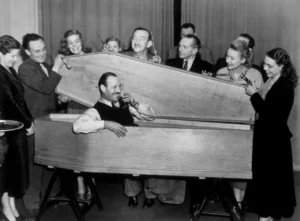
In the annals of World War II deception, few names are as polarizing as Jasper Maskelyne. A 37-year-old stage magician from a legendary dynasty of British illusionists, Maskelyne joined the Royal Engineers in 1940. By 1941, he was in North Africa, claiming to use “the art of the stage” to defeat Field Marshal Erwin Rommel.
For decades, popular history has painted Maskelyne as the mastermind who hid the Suez Canal and moved the Port of Alexandria. However, records suggest a more complex reality: one where the line between military camouflage and theatrical tall tales is blurred.
The “Magic Gang” and the Camouflage Directorate

Maskelyne was part of a specialized unit in Cairo known as the Camouflage Directorate, often nicknamed the “Magic Gang.” This group was not composed of sorcerers, but of architects, set designers, and chemists. Their commander was Brigadier Dudley Clarke, the true pioneer of strategic deception in the Middle East and the founder of the “A” Force.
While Maskelyne was a vital member of this team, he was a camouflage officer working within a massive military hierarchy. His stage background gave him a unique perspective on visual misdirection, but he was one cog in a highly organized machine.
The Legend vs. The Record: Fact-Checking the “Big Tricks”

In his 1949 memoir, Magic: Top Secret, Maskelyne claimed credit for several staggering feats. Here is how they hold up against historical military scrutiny:
- The Alexandria Decoy: Maskelyne claimed he created a “fake” Port of Alexandria at Maryut Bay, using lights to trick the Luftwaffe into bombing an empty shoreline.
- The Fact: While “Starfish” decoy sites (using controlled fires and lights) were standard British deception tactics used to protect Alexandria, there is no archival evidence that Maskelyne designed or commanded the operation personally.
- Hiding the Suez Canal: Maskelyne described a system of “strobe lights” mounted on searchlights to blind German pilots.
- The Fact: Anti-aircraft searchlights were used as “dazzle” defenses, but historians like Rick Stroud and Richard Stokes note that these were developed by the Royal Engineers and the Admiralty, not a solo magician.
- Operation Bertram (The Sunshield): Maskelyne’s most famous claim is the “Sunshield”—a canvas cover that made a Crusader tank look like a 10-ton supply truck from the air.
- The Fact: The Sunshield was a masterpiece of the El Alamein campaign. However, patent and design records credit Commander Geoffrey Barkas and architect Tony Ayrton as the primary designers.
The Reality of Desert Deception

Regardless of Maskelyne’s personal exaggerations, the deception operations in North Africa were a masterpiece of military engineering. Before the Second Battle of El Alamein in 1942, the British successfully:
- Deployed thousands of dummy tanks and artillery pieces in the south to draw German attention away from the north.
- Used “Dummy Pipelines” made of discarded petrol cans to trick German recon into thinking the British wouldn’t be ready to attack for weeks.
- Concealed real fuel dumps inside food crates to hide the massive buildup of supplies.
These efforts, collectively known as Operation Bertram, are credited by General Bernard Montgomery as a key factor in the Allied victory.
Why the Maskelyne Myth Persists

Military historians have spent years debunking Maskelyne’s grander claims, yet the story remains a staple of WWII lore. Maskelyne understood the “prestige” of a trick; he was a master of the narrative. In an era before declassification, his memoir was one of the few accounts of wartime deception available to the public. He cast himself as the protagonist in a story that was actually written by a committee of brilliant, anonymous engineers and architects.
The Real Legacy
Jasper Maskelyne was a real soldier who performed real camouflage work. He was an expert at using paints, mirrors, and dummy structures to disrupt the enemy’s “visual intelligence.” While he may not have been the “man who single-handedly fooled the [Germans],” his story highlights a critical truth of WWII: the war was won as much by intellectual misdirection as it was by firepower.