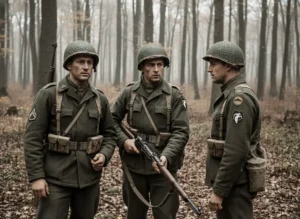
When people think of World War II, they imagine tanks, rifles, and massive armies clashing across Europe. But one of the most unusual and effective U.S. units fought with none of those things. Known as the Ghost Army, the 23rd Headquarters Special Troops used art, sound, and illusion to convince the Nazi high command that entire divisions were present where there were none.
A Unit of “Combat Con Artists”

Activated in January 1944, the Ghost Army was the first mobile, multimedia, tactical deception unit in U.S. history. Its 1,100 members were handpicked for their high IQs and creative skills. The unit consisted of four distinct companies, each specializing in a different “layer” of the illusion:
- 603rd Engineer Camouflage Battalion: Handled visual deception with inflatable rubber tanks and vehicles.
- Signal Company Special: Conducted “spoof radio” to mimic the communication patterns of real units.
- 3132 Signal Service Company: The “sonic” wing, using massive speakers to broadcast the sounds of armored divisions.
- 406th Engineer Combat Company: Provided security and “atmospheric” details, like fake physical tracks in the mud.
The Engineering of Illusion: How it Worked

To adhere to the “Show, Don’t Just Tell” principle, it is important to understand the technical “why” behind their success.
Visual Deception: The 93-Pound Sherman
The unit’s primary tool was the inflatable M4 Sherman tank. Made of neoprene-coated fabric, these decoys weighed only 93 pounds but were indistinguishable from 30-ton steel tanks from a distance of several hundred yards.
- Why it worked: Designers used gasoline-fueled air compressors to inflate these “targets” in under 20 minutes. By placing them under imperfect camouflage, they invited German reconnaissance planes to “discover” them, confirming the enemy’s false intelligence.
Sonic Deception: The 15-Mile Reach
The unit used 500-pound speakers mounted on halftracks to play “soundscapes” recorded at Fort Knox.
- The Technical Edge: These recordings were mixed to include the clanking of treads, the shouting of sergeants, and even the sounds of bridge construction. According to the Ghost Army Legacy Project, these sounds could be projected up to 15 miles away, creating a terrifying auditory illusion of an approaching armored column.
Operation Viersen: The Masterclass of 1945

The Ghost Army’s greatest success occurred during the crossing of the Rhine River in March 1945. To protect the Ninth Army’s real crossing, the Ghost Army simulated two full divisions—roughly 30,000 men—ten miles away.
By using more than 600 inflatable vehicles and “spoofing” radio traffic, they drew German artillery and reinforcements toward the decoy site. This allowed the real Ninth Army to cross with almost no resistance. Historians and military officials estimate this single operation saved between 15,000 and 30,000 American lives.
Why the Story Matters Today
The Ghost Army was so successful that its tactics remained classified until 1996. Their legacy lives on in modern psychological operations (PSYOP) and “maskirovka” (military deception). In 2022, the surviving members were awarded the Congressional Gold Medal, finally receiving the recognition their secret service deserved.
Experience the sounds of the Ghost Army:
This video provides a deep dive into the 23rd Headquarters Special Troops, featuring archival footage of the inflatable tanks and original sonic recordings used to deceive German forces.