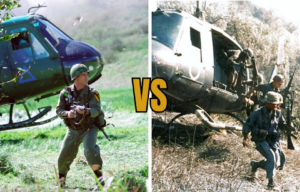
‘We Were Soldiers’ does not follow the historical events of the Vietnam War exactly, and changed key moments from the Battle of Ia Drang

Photo Credit: 1. andrewz / Paramount Pictures / MovieStillsDB 2. Unknown Author / Wikimedia Commons / Public Domain (Colorized by Palette.fm)

Released in 2002, We Were Soldiers received widespread acclaim for its stark and unflinching portrayal of the Vietnam War, particularly the intense combat of the Battle of Ia Drang. Directed by Randall Wallace, the film was adapted from We Were Soldiers Once… and Young, the memoir by Harold G. Moore and Joseph L. Galloway—both of whom had firsthand experience in the battle, lending the story a strong foundation of authenticity.

While the film is frequently praised for the realism of its combat sequences, it does not follow historical events in every detail. Certain scenes—particularly those portraying soldiers returning home—were intentionally heightened for dramatic impact. These moments were crafted to provide emotional closure and emphasize the personal cost of war rather than to serve as exact historical reconstructions.

Despite these narrative liberties, the film is widely regarded as a faithful depiction of the soldiers’ experiences. At its heart, We Were Soldiers remains a powerful tribute to the courage, sacrifice, and resilience displayed during one of the Vietnam War’s earliest and most significant engagements.

What is We Were Soldiers about?

Mel Gibson as Lt. Col. Hal Moore in 'We Were Soldiers'
We Were Soldiers, 2002. (Photo Credit: Zayne / Paramount Pictures / MovieStillsDB)

We Were Soldiers is based on the novel, We Were Soldiers Once… and Young: Ia Drang – The Battle That Changed the War in Vietnam, by renowned war correspondent Joe Galloway and Lt. Gen. Hal Moore. Both were present at the Battle of Ia Drang, the first large-scale engagement of the Vietnam War.

The film follows the experiences of both Moore, portrayed by Mel Gibson, and his wife, Julia, played by Madeleine Stowe. The former arrives in Vietnam in November 1965, and, soon after, is tasked with leading his 400 men in an effort to take out the enemy troops who attacked one of the bases in the Ia Drang Valley. Outnumbered when they arrive, the men are forced to fight for their lives while eliminating the 4,000-strong North Vietnamese force.

The secondary plot follows Julia, who volunteers to deliver telegrams informing families of their loved ones’ deaths in Vietnam.

The ending of We Were Soldiers

Still from 'We Were Soldiers'
We Were Soldiers, 2002. (Photo Credit: Zayne / Paramount Pictures / MovieStillsDB)

In the film’s climactic moments of We Were Soldiers, Lt. Col. Hal Moore orders a “Broken Arrow”—an emergency distress call authorizing all available U.S. aircraft to strike directly on his own position. Reserved for situations of extreme peril, the call signals that his battalion is on the brink of being overrun during the Battle of Ia Drang. Waves of airstrikes pound the battlefield, halting the North Vietnamese and Viet Cong advance. The overwhelming response, however, carries tragic consequences, as several American soldiers are caught in the friendly fire, underscoring the desperation of the moment.

Exhausted and bloodied, Moore’s troops slowly regroup and reestablish their defensive perimeter as the enemy assault loses momentum. Eventually, North Vietnamese forces disengage, leaving the battered U.S. unit in temporary control of the field.

As the fighting subsides, evacuation preparations begin. Staying true to his leadership principles, Moore refuses to leave until every soldier is accounted for, dead or alive—a decision that highlights his deep sense of responsibility and the bond within the unit.

After American forces withdraw, North Vietnamese troops later reoccupy the battlefield. Moore remains in Vietnam for another year, enduring further combat before finally returning home. His quiet reunion with his wife, Julia, closes the narrative on a reflective note, offering emotional contrast to the violence of Ia Drang and a measure of release after the relentless strain of war.

Battle of Ia Drang

Bell UH-1D Iroquois hovering over two American soldiers
American troops in the Ia Drang Valley, November 1965. (Photo Credit: US Army / Wikimedia Commons / Public Domain)

The actual Battle of Ia Drang occurred from November 14-19, 1965, and the intense fighting primarily centered around two key helicopter landing zones: LZ X-Ray and LZ Albany. The 1st Battalion, 7th Cavalry Regiment, under the command of Lt. Col. Hal Moore, was heavily engaged in combat at LZ X-Ray for three days starting on November 14, 1965.

While We Were Soldiers captures much of the battle’s intensity and bravery, the film deviates from the historical facts in its portrayal of the battle’s conclusion. In the movie, the battle ends with Moore’s forces successfully evacuating and completing a dramatic final charge. In reality, however, the battle didn’t officially conclude until LZ Albany was reclaimed by American forces, which marked the true end of the engagement.

Additionally, the majority of the 2nd Battalion, 7th Cavalry Regiment, led by Lt. Col. Robert McDade, didn’t enter the fight until after Moore’s forces had been relieved at LZ X-Ray. After Moore’s men were airlifted out, McDade’s battalion was reinforced by the 2nd Battalion, 5th Cavalry Regiment, and took over the fight to secure LZ Albany.

LZ Albany

American troops walking through the Vietnamese jungle
American troops in the Ia Drang Valley, 1965. (Photo Credit: Tim Page / CORBIS / Getty Images)

The next day, both battalions were warned that enemy bombers were headed toward LZ X-Ray, forcing them to move. The 2nd Battalion, 5th Cavalry Regiment marched toward LZ Columbus, while the 2nd Battalion, 7th Cavalry Regiment made their way to LZ Albany, capturing two North Vietnamese soldiers along the way. These prisoners were questioned by McDade, who, along with most of the battalion’s officers and radio operators, was called to a meeting to go over the gathered intelligence.

At the same time, the rest of the 2nd Battalion was left waiting with no communication. Exhausted from the battle at X-Ray, they were unprepared when hundreds of enemy troops slipped in unnoticed and launched an attack. The battalion heading to Columbus soon received word of the assault, leading Bravo Company to turn back to Albany as reinforcements. Their arrival helped push back the enemy, making it possible to evacuate the wounded.

Conclusion of the Battle of Ia Drang

US soldiers disembarking from a helicopter
US forces during the beginning stages of the Battle of Ia Drang, November 1965. (Photo Credit: Pictures From History / Universal Images Group / Getty Images)

There were no further attacks overnight. On November 18, 1965, the US forces were able to gather their dead. Although the fighting had ended, the Battle of Ia Drang didn’t officially conclude until the next day, as it took two days to collect the bodies.

James Lawrence, one of the men who fought at LZ Albany, later recounted his experiences. He wanted to ensure the memories of those who died live on, in particular that of his best friend, Lt. Don Cornett.

Recalling the aftermath of the fight, he said, “Back then Stars and Stripes would carry the casualty reports and I had a red pen and started checking off the names of guys I knew who were listed as KIA. I marked off 65 names and that’s when it really hit me what had happened and it just overwhelmed me. I couldn’t grasp it.”

More from us: Val Kilmer Accidentally Landed Matthew Modine the Starring Role in ‘Full Metal Jacket’

Although it was left out of We Were Soldiers, Albany was no less bloody than X-Ray. Of the 500 men present as part of the 2nd Battalion, 7th Cavalry Regiment, 155 lost their lives, and just 84 were immediately able to return to active duty.

Rosemary Giles

Rosemary Giles is a history content writer with Hive Media. She received both her bachelor of arts degree in history, and her master of arts degree in history from Western University. Her research focused on military, environmental, and Canadian history with a specific focus on the Second World War. As a student, she worked in a variety of research positions, including as an archivist. She also worked as a teaching assistant in the History Department.

Since completing her degrees, she has decided to take a step back from academia to focus her career on writing and sharing history in a more accessible way. With a passion for historical learning and historical education, her writing interests include social history, and war history, especially researching obscure facts about the Second World War. In her spare time, Rosemary enjoys spending time with her partner, her cats, and her horse, or sitting down to read a good book.

linkedin.com/in/rosemary-giles