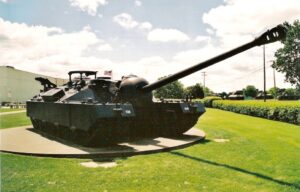
Photo Credits: Yellowute / English Wikipedia / Wikimedia Commons / Public Domain (cropped).
The advent of tanks in World War I revolutionized battlefield tactics, and by the Second World War, the U.S. sought to push armored warfare even further with the T28 Super Heavy Tank. Engineered as a colossal assault vehicle, it was intended to smash through fortified positions while enduring punishing enemy fire, essentially serving as a mobile fortress on tracks.
Ambition, however, met reality: the program never progressed beyond the prototype stage. Only two examples were built—one was sidelined by mechanical problems during testing, while the other inexplicably disappeared for years. Its vanishing sparked intrigue, rumor, and speculation, leaving the T28 enshrouded in enduring mystery.
The United States wanted to match the German Army’s powerful tanks
The prototype models for the T28 Super Heavy Tank had double-tracked treads. (Photo Credit: Pahcal123 / Wikimedia Commons CC BY-SA 4.0)
Following the Allied victory in World War II, the United States examined the lessons learned from confronting Germany’s sophisticated armored tactics, particularly along the formidable Siegfried Line. Breaching these defenses had been a major challenge, highlighting the need for a new approach to armored warfare.
In response, the U.S. began developing the T28 Super Heavy Tank in 1943. This massive vehicle was designed to endure intense enemy fire while breaking through fortified positions, providing maximum protection for its crew within an exceptionally thick armored hull.
The United States begins work on developing prototypes
The T28 Super Heavy Tank was meant to smash through the German Army’s Siegfried Line. (Photo Credit: Mark Holloway / Wikimedia Commons CC BY 2.0)
In March 1944, work began on building five T28 Super Heavy Tanks. Each was armed with a powerful 105mm T5E1 anti-tank gun as its main weapon and a .50-cal Browning heavy machine gun for additional defense. The tank featured exceptionally thick armor, with some sections up to 12 inches thick, making it highly resistant to enemy anti-tank weapons.
However, production faced significant challenges. The T28 was extremely heavy, weighing 95 short tons, which limited its top speed to just 8 miles per hour. Its massive weight also made it difficult to maneuver across different types of terrain.
The T28 Super Heavy Tank wasn’t really needed at all
The original intention was for the T28 Super Heavy Tank was to smash through the German Army’s Siegfried Line. (Photo Credit: Fox Photos / Getty Images)
The T28 Super Heavy Tank was initially conceived as a breakthrough weapon intended to penetrate Germany’s heavily fortified Siegfried Line. By mid-1944, however, the rapid Allied advance had diminished the strategic value of those defenses, and by early 1945, the line had effectively collapsed. With its original mission rendered obsolete, military planners briefly considered deploying the T28 in a potential invasion of Japan.
That possibility vanished with Japan’s surrender following the atomic bombings. The program was subsequently terminated, leaving only two completed prototypes. One was severely damaged during testing at Yuma Proving Ground and ultimately abandoned, marking the quiet end of one of the most ambitious armored vehicle projects of the war.
The remaining T28 Super Heavy Tank was lost for decades
A look at the rear of the T28 Super Heavy Tank. (Photo Credit: Mark Holloway / Wikimedia Commons CC BY 2.0)
As World War II came to an end and military tactics evolved, the T28 Super Heavy Tank quickly became obsolete. Testing highlighted several problems that would have made it difficult to deploy effectively in combat. As a result, the U.S. military shifted its focus to tanks that were lighter, faster, and more versatile across different terrains.
The T28’s absence on the battlefield during the Korean and Vietnam Wars was noticeable. Its bulky, World War II-era design no longer aligned with the military’s changing requirements and was eventually phased out as strategy and technology advanced.
The T28 Super Heavy Tank was eventually found in the weeds
Photo Credits: Yellowute at English Wikipedia / Wikimedia Commons / Public Domain.
The military’s concentration on developing new tanks led to the misplacement of the remaining T28 Super Heavy Tank prototype. Remarkably, it wasn’t until 1974, a staggering 27 years after its disappearance, that it was stumbled upon in a field at Fort Belvoir, Virginia. Neglected and exposed to the elements for decades, weeds had begun to encroach upon its structure.
Following its rediscovery, the prototype received significantly better care and reverence. It was relocated to the General George Patton Museum at Fort Knox, Kentucky, where it resided for several years before finding a permanent home at Patton Park in Fort Moore (formerly Fort Benning), Georgia.