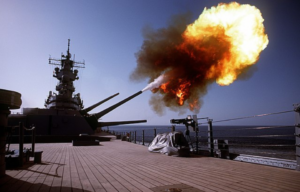

The USS Wisconsin was designed in 1938 by the Preliminary Design Branch of the Bureau of Construction and Repair. Her construction officially began on January 25, 1941, at the Philadelphia Navy Yard, making her the third Iowa-class “fast” battleship.
She was launched on December 7, 1943, and officially entered service the following year. After completing initial tests in Chesapeake Bay, she left Norfolk, Virginia, for a training cruise in the British West Indies.
From there, she traveled through the Panama Canal on her way to the Pacific.
USS Wisconsin (BB-64) specs

The USS Wisconsin‘s main armament included nine 16-inch/50 cal. Mk 7 guns in three turrets, which could fire 2,700-pound armor-piercing shells up to 20 miles. In addition to this, she was equipped with twenty 5-inch/38 cal. guns in 10 turrets, forty-nine Oerlikon 20 mm cannons and eighty Bofors 40 mm anti-aircraft guns.
During the 1980s, Wisconsin had her anti-aircraft guns replaced with Phalanx CIWS mounts. She also had her five-inch/38 cal. gun total reduced to 12, and received armored box launchers, which fired Tomahawk missiles, and quad cell launchers capable of firing Harpoon missiles.
Wisconsin and the USS Missouri (BB-63) had 14.5-inch-thick bulkheads, compared to their sister ships, the USS Iowa (BB-61) and New Jersey (BB-62), which only had 11.3-inch bulkheads. The rest of Wisconsin’s armor, however, was identical to the other Iowa battleships.
Wisconsin, like her sister ships, also carried floatplanes during the Second World War. Early on in the Cold War, a helicopter pad was positioned at the stern. Toward the end of their service life, each ship in the class could carry up to five unmanned aerial vehicles (UAVs).
Making waves in the Pacific during World War II

After departing the West Coast for Hawaii and the Caroline Islands, the USS Wisconsin joined Adm. William Halsey‘s Third Fleet on December 9, 1944. While she’d missed out on most of the Second World War, the battleship saw combat shortly after joining the conflict.
In preparation for the US invasion of Mindoro, Wisconsin joined the Fast Carrier Task Force (TF-38), charged with softening Japanese defenses ahead of American ground forces. During her first operation, the task force came up against Typhoon Cobra. Three destroyers sank, a number of ships were damaged and hundreds of sailors were either killed, missing or injured. Somehow, Wisconsin got out unscathed, reporting just two injured crewmen.
Wisconsin went on to help in the occupation of Luzon, acting as a carrier escort and protecting the vessels from air attacks. In February 1945, she joined the Fifth Fleet’s Task Force 58 (TF-58), pushing north toward Japan. During this time, the battleship provided support and assisted in the landing of troops on Iwo Jima. She also engaged shore-based targets on Hachinohe, Okinawa and Tokyo.
Wisconsin was caught in another typhoon on June 4, once again riding out the storm completely untouched. On September 5, she sailed into Tokyo Bay, just three days after the formal surrender had been signed aboard her sister ship, the USS Missouri.
Over the course of her short service during the Second World War, Wisconsin sailed 105,831 nautical miles. With the conflict over, she took part in Operation Magic Carpet, after which she was put into the Atlantic Reserve Fleet and made inactive.
‘TEMPER TEMPER’

At the outbreak of the Korean War, the USS Wisconsin was reactivated for duty. Following a shakedown cruise and two training voyages with midshipmen, she departed Norfolk on October 25, 1951, bound for the Pacific theater.
After transiting the Panama Canal, Wisconsin arrived in Japan on November 21, assuming the role of flagship for Vice Adm. H.M. Martin of the Seventh Fleet, taking over from the USS New Jersey. Just five days later, she sailed for Korea to join Task Force 77 (TF‑77), where she was tasked with executing shore bombardment missions.
On March 15, 1952, while targeting enemy positions near Songjin, Wisconsin faced incoming fire from 155 mm North Korean artillery as she approached the coast. Three sailors were wounded, but the ship itself sustained no significant damage. In retaliation, she lost her temper and delivered a devastating broadside that obliterated the enemy guns. Observing the action, her escort vessel, the USS Buck (DD‑761), sent a tongue-in-cheek message: “TEMPER TEMPER.”
Though documentation of the incident is somewhat sparse, it has endured as a vivid and oft-recounted tale of the battleship’s firepower and presence in the Korean War.
The USS Wisconsin (BB-64) returns to the United States

This quiet period ended suddenly on May 6, 1956, when heavy fog led Wisconsin to collide with the destroyer USS Eaton, causing serious damage to her bow. The Navy executed an unusual yet effective solution: the damaged section was replaced using the unfinished bow of the USS Kentucky. Repairs proceeded swiftly, and by late June, Wisconsin was fully restored and seaworthy.
She remained in active service for another two years before being moved to the Reserve Fleet. On March 8, 1958, Wisconsin officially entered reserve status, fully refitted and maintained in a state of readiness should she ever be needed again.
Gulf War

On August 1, 1986, the Wisconsin was reactivated as part of President Ronald Reagan and Navy Secretary John F. Lehman’s attempt to create a “600-ship Navy.” During the late ’80s, she underwent modernization and was recommissioned.
Following the Iraqi invasion of Kuwait, US naval forces were deployed as part of Operation Desert Shield. When Operation Desert Storm began, Wisconsin and the USS Missouri launched Tomahawk strikes against Iraq. They were some of the first ships to use cruise missiles during the Gulf War, with Wisconsin serving as the Tomahawk Land Attack Missile (TLAM) strike commander. The conflict also saw the battleship, for the first time since 1952, provide gunfire support.
More from us: USS Harder (SS-257): The WWII-Era Submarine That Took Out Five Enemy Destroyer In Four Days
Over the course of the war, both Wisconsin and Missouri fired more than one million pounds of ordnance on Iraqi targets. With the end of the conflict, all four Iowa-class battleships were decommissioned.