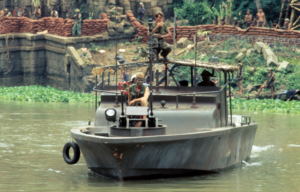
PBRs were developed from pleasure boats

The Patrol Boat, River (PBR) was developed by Willis Slane and Jack Hargrave of Hatteras Yachts. Only a week after meeting with U.S. Navy officials, the pair produced a prototype using a hull derived from an existing Hatteras design. The completed PBR design also drew inspiration from a Uniflite pleasure boat, along with other influences.
After testing the prototype, the U.S. Navy awarded a contract in October 1965 for 140 boats. By March 1966, 11 had been delivered to support Operation Game Warden, the American effort to prevent the Viet Cong from moving supplies and resources through the Mekong Delta.
Over the following years, approximately 300 PBRs were provided to U.S. and South Vietnamese forces. They became a key asset during the Vietnam War, serving throughout the conflict from 1966 until 1975.
Built for Vietnam’s shallow, weed-filled rivers

The Patrol Boat, River, better known as the PBR, was a light, highly maneuverable fiberglass craft designed for rapid movement through Vietnam’s complicated network of inland waterways. Two main versions were used during the conflict: the Mark I and the somewhat larger Mark II. Although their overall designs were similar, the Mark II was 32 feet long and 11 feet, 7 inches wide, while the Mark I measured 31 feet in length with a beam of 10 feet, 7 inches.
Agility was one of the PBR’s defining characteristics. The boat could turn within its own length, make abrupt changes in direction, and come to a stop remarkably quickly. With a draft of only about two feet, even a fully loaded PBR could operate in the narrow, vegetation-choked channels of the Mekong Delta. Ceramic armor provided protection around the cabin, while a gun tub at the bow offered the forward gunner a clear field of fire.
Its combination of speed, agility, and armament made the PBR particularly valuable for river patrols in areas that larger vessels could not reach. The boats were widely operated by the U.S. Navy’s River Patrol Force, designated Task Force 116, and were also used by supporting organizations, including the U.S. Army’s 458th Transportation Company (LARC).
Four sailors normally made up a PBR crew: a petty officer first class serving as boat captain, along with a gunner’s mate, an engineman, and a seaman. Crew members were trained to perform one another’s duties so operations could continue if someone became a casualty. At times, an interpreter was also carried to help the crew navigate the delta’s complicated waterways.
PBRs were stacked with weaponry

Each Patrol Boat, River was equipped with a plethora of weapons, meaning it could hold its own in a firefight. The forward bow turret had twin M2HB Browning heavy machine guns, while the rear pintle mounting was equipped with either a single Browning or an M60 light machine gun. The pintle mounting amidship featured either an Mk 19 grenade launcher or a single Browning.
PBRs could also hold 81 mm mortar launchers, Mk 16 Mod 4 Colt 20 mm automatic cannons and flamethrowers, and had a full complement of hand grenades, shotguns, M16 rifles and .45-caliber ACP handguns manned by the crew.
Earning the Medal of Honor aboard a PBR

There are several instances where PBRs and their crews engaged with the enemy. One such instance occurred in October 1966, for which BM1. James E. “Willie” Williams was awarded the Medal of Honor for his bravery.
Williams was the captain of PBR-105 and another patrol boat tasked with searching for Viet Cong guerrillas along a section of the Mekong Delta. While doing so, the group came under heavy fire from two enemy sampans and immediately engaged with those aboard the vessels.
Williams’ men successfully killed the crew of one of the enemy boats and caused the other to seek refuge. While pursuing the sampan, they were met with heavy small-arms and rocket-propelled grenade (RPG) fire from guerrillas hidden behind brush along the riverbank.
To counter, Williams exposed himself to the enemy fire to direct his crew. They were heavily outnumbered, so the captain called for aerial support from American Bell UH-1B Iroquois helicopters. As they maneuvered the river, PBR-105 came upon an even larger concentration of enemy boats and troops. Choosing not to wait for the choppers, Williams instead led his men through the intense gunfire.
By this point, it had gotten dark, and Williams ordered that the PBRs’ searchlights be turned on, despite the target that would inevitably be placed on the vessels. They, again, engaged with enemy forces stationed onshore. Through Williams’ direction, his crew wound up destroying over 50 Viet Cong vessels and took out an estimated 1,000 guerrillas.
More from us: HMS Victory: The World’s Oldest Warship Still In Commission
On May 14, 1968, US President Lyndon B. Johnson presented Williams with the Medal of Honor, just one of the numerous decorations he received throughout his career in the US Navy.