In the aftermath of World War II, former battlefields across the globe remained littered with abandoned weapons, vehicles, and military equipment ranging from small arms to armored tanks. Many discoveries made today are relatively common—items such as shell casings, damaged helmets, or discarded grenades still emerge decades after the fighting ended.
From time to time, however, far more unusual relics are uncovered. Intact aircraft, rusted armored vehicles, and even unexploded ordnance occasionally resurface, blending historical intrigue with genuine danger. These remnants continue to attract the attention of historians, collectors, and researchers, offering tangible links to a war that profoundly reshaped the modern world.
Chartres is no stranger to war
Free French fighters following the liberation of Chartres, 1944. (Photo Credit: Robert Capa / Keystone / Getty Images)
Chartres is no stranger to conflict, having experienced it for decades, and this was no different during World War II. It was one of many European cities to suffer heavy bombings during the early years of the conflict, and it was also the site of intense fighting in August 1944, just over two months after the D-Day landings at Normandy.
The Americans spearheaded the advance into the city with orders to expel the German forces and demolish the grand cathedral, which commanders feared might serve as an enemy observation post. On August 16, Col. Welborn Barton Griffith, Jr., a liaison officer with the XX Corps, questioned if this was necessary and proposed a reconnaissance mission behind enemy lines to confirm whether the bell tower was actually in use. When it was determined that the tower was unoccupied, the demolition order was rescinded, sparing the historic cathedral from destruction.
Fighting to liberate Chartres
Gen. Charles de Gaulle, acknowledging the tumultuous welcome given to him by residents of Chartres, France, 1944. (Photo Credit: Bettmann / Getty Images)
While German forces never occupied Chartres Cathedral itself, they held tight control over the surrounding town, transforming it into a defensive position intended to slow the Allied advance. American formations, including the 3rd Cavalry Group and the 1139th Engineer Combat Group, advanced to locate and eliminate German strongpoints but faced determined opposition. The battle grew more intense as Free French troops and members of the French Resistance entered the fight, making Chartres the scene of heavy combat.
On August 18, 1944, soldiers from the U.S. 5th Infantry Division and 7th Armored Division, serving under Gen. George Patton’s Third Army, broke through the German defenses and liberated Chartres. Their success created a crucial route toward the liberation of Paris and marked an important milestone in the effort to drive German forces out of France.
Workers thought they were conducting normal road maintenance…
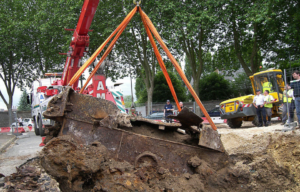
Mechanical digger lifting an M5 Stuart from the 31st Tank Battalion out of the ground, 2008. (Photo Credit: ALAIN JOCARD / AFP / Getty Images)
In 2008, a group of road workers performing routine maintenance near Chartres made an unexpected discovery. During excavation close to the famed cathedral, they accidentally unearthed what appeared to be a sizable machine located right in the area where they were working.
An amazing discovery beneath the streets of Chartres
A mechanical digger lifting an M5 Stuart from the 31st Tank Battalion out of the ground, 2008. (Photo Credit: ALAIN JOCARD / AFP / Getty Images)
The discovery of the unusual metal object left the excavation team stunned and uncertain about what they had found. Initial attempts to place it onto a truck were unsuccessful because it was far too heavy to be moved manually. To remove it safely, an excavator was later used to lift the massive object from the ground.
Even after it had been recovered, its purpose remained unclear, leading researchers to seek input from experts. Following a comprehensive analysis, historians concluded that the artifact was connected to the liberation of Chartres during the Second World War.
A long-lost M5 Stuart
A mechanical digger lifting an M5 Stuart from the 31st Tank Battalion out of the ground, 2008. (Photo Credit: ALAIN JOCARD / AFP / Getty Images)
According to experts, the unidentified vehicle was identified as an American tank that played a role in the liberation of France in 1944. Remarkably, they were able to locate witnesses who remembered seeing the vehicle during the liberation efforts, operated by US troops.
Serving with the 31st Tank Battalion
A mechanical digger lifting an M5 Stuart from the 31st Tank Battalion out of the ground, 2008. (Photo Credit: ALAIN JOCARD / AFP / Getty Images)
The M5 Stuart light tank, as they identified it, had served with Maj. Leslie Lohse of the 31st Tank Battalion, 7th Armored Division, who’d helped with the liberation of Chartres. The tank was the first to enter the city during the Allied liberation efforts, but it was abandoned while on a reconnaissance mission, with witnesses stating it had either slipped off of its tracks or ran out of fuel.
When World War II was over, the M5 was pushed into a bomb crater and buried, as a means of clearing the road. For the next eight decades, it remained beneath the ground, with few aware of its existence.
The M5 Stuart was developed by the Americans in 1942 as an upgrade to the earlier M3 light tank. Facing a shortage of radial aero-engines, the U.S. Army sought an alternative powerplant, ultimately selecting Cadillac’s V8 engine to drive the redesigned armored vehicle, which also sported a revamped hull.
By the conclusion of World War II, production totaled 2,074 units. Though effective in combat, the M5 Stuart was relatively compact compared with other tanks of the era.
No match for larger enemy tanks
M5 Stuart, 1945. (Photo Credit: U.S. Army / Department of Ordnance – Army Ground Forces / Development of Armored Vehicles, Volume I: Tanks / Wikimedia Commons / Public Domain)
It’s not unusual that the discovery made in Chartres was an M5, given it was readily used by the Americans during their push into France. However, it was a poor match for enemy vehicles, as it was only equipped with a 37 mm cannon, compared to the 88 mm ones many German tanks were equipped with.