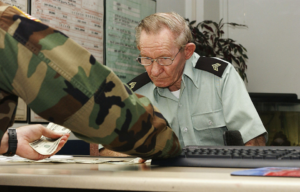
Charles Robert Jenkins enlisted when he was 15 years old

Charles Robert Jenkins entered the world on February 18, 1940, in Rich Square, North Carolina. His early years were marked by a sports injury and the passing of his father, which contributed to his not completing his education at Rich Square High School.
Lacking a high school diploma, Jenkins found his job prospects restricted. As a result, he enlisted in the North Carolina National Guard, serving from 1955 to 1958, which covered most of his teenage years.
Joining the US Army

Following an honorable discharge, Charles Robert Jenkins chose to return to military service, reenlisting in the U.S. Army at age 18. He was sent to Fort Hood, which is now called Fort Cavazos, and underwent infantry training with an emphasis on light weapons. His career soon took him abroad after he volunteered for duty in South Korea, where he served with the 7th Infantry Division between August 1960 and September 1961. After completing his assignment in South Korea, Jenkins was transferred to the 3rd Armored Division in West Germany. He remained on active duty there until 1964.
Deserting the US Army

In 1964, Charles Robert Jenkins began his second tour in South Korea, stationed along the tense and heavily guarded Korean Demilitarized Zone. Assigned to the 8th Cavalry Regiment of the 1st Cavalry Division, he operated under constant strain while patrolling one of the world’s most dangerous frontiers. On the night of January 5, 1965, his life took a decisive turn. Worn down by the demands of border duty and fearful that his unit would soon be sent to Vietnam, Jenkins crossed into North Korea, believing the Soviets would offer protection and eventually arrange his return to the United States through a prisoner exchange.
Crossing the Korean Demilitarized Zone (DMZ)

On the night Charles Jenkins deserted, he put away 10 beers before setting out on patrol with several other soldiers. At about 2:30 a.m., he told the group he was checking out a suspicious sound, using the claim to leave unnoticed. As he approached the Demilitarized Zone, Jenkins unloaded his M14 rifle and tied a white T-shirt to its barrel to serve as an improvised surrender flag.
Jenkins crossed into North Korea expecting that he would soon be sent back to the United States. Instead, North Korean authorities detained and interrogated him, and he remained there for the next 39 and a half years.
Immediately regretting his decision

It wasn’t long after his capture and detention that Charles Robert Jenkins regretted his decision to defect to North Korea; it was not the experience he’d expected it to be.
In a 2006 interview with British publication The Independent, he called his desertion “the biggest mistake I ever made,” and in his 2008 memoir, The Reluctant Communist: My Desertion, Court-Martial and 40-Year Imprisonment in North Korea, wrote that he hadn’t realized the nation was essentially a giant “prison.”
He also explained his mindset at the time, writing, “I was not thinking clearly. But at the time my decisions had a logic to them that made my actions seem almost inevitable.”
Word of Charles Robert Jenkins’ defection spreads

Just under two weeks after crossing the DMZ, Charles Robert Jenkins’ defection was announced on North Korean radio, which stated his decision was “because of disgust with conditions in South Korea and that he believed life was better under the Communists.”
The United States confirmed him to be a deserter based on four letters he’d sent to his mother, one of which read, “Forgive me, for I know what I must do. Tell my family I love them. Love, Charles.”
Charles Robert Jenkins was housed with other defectors

Jenkins was housed with three other American deserters while under the regime’s watchful eye:
- James Dresnok, who defected in August 1962.
- Larry Abshier, who crossed the DMZ in May 1962.
- Jerry Parrish, who deserted his post in 1963.
The conditions the four were held in were horrible; they shared one room and were beaten when they failed to properly memorize the works of Kim Il-Sung. While the group had decided to cross over into North Korea, they hadn’t necessarily planned to remain. In 1966, they attempted to follow Jenkins’ original plan to seek asylum through the Soviet embassy, but they were unsuccessful.
Working for the North Koreans

Years later, the four men were granted citizenship, provided with homes and jobs, and eventually given wives. However, despite these changes, their living conditions remained much the same. Charles Robert Jenkins later wrote that he “suffered from enough cold, hunger, beatings, and mental torture to frequently make me wish I was dead.”
Even though they were officially considered “citizens,” their captors still didn’t trust them. Their homes were bugged and surrounded by barbed wire to prevent any escape attempts. The men were also forced to act in propaganda films, playing the roles of villainous Americans. Jenkins was assigned to teach English to North Korean spies and soldiers, but his thick Southern accent eventually led to his removal from the job.
Charles Robert Jenkins marries Hitomi Soga

In 1980, Charles Robert Jenkins was introduced to Hitomi Soga, a Japanese nurse who’d been kidnapped a few years earlier to serve as a teacher for North Korean spies. Their union was forced, with the ceremony taking place just weeks after they first met.
Despite the lack of choice in the matter, the two developed a deep bond. Jenkins later told The Independent, “When I met her, my life changed a lot. Me and her together—I knew we could make it in North Korea. And we did.”
Over the next five years, they had two daughters, Mika (1983) and Brinda (1985).
Hitomi Soga attempts to free her husband

Charles Robert Jenkins was ultimately able to leave North Korea thanks in large part to the determined efforts of his wife, Hitomi Soga. Following the 2002 Japan-North Korea Pyongyang Declaration, Soga and four other Japanese abductees were allowed to visit Japan on what was supposed to be a ten-day trip. Instead of returning to North Korea, she stayed in Japan and appealed to Japanese officials in an attempt to obtain a U.S. pardon for Jenkins, but those efforts did not succeed.
Had Jenkins traveled to Japan at that time, he would have been subject to prosecution by the U.S. military for desertion. The statute of limitations was forty years, and he had been away for approximately thirty-nine and a half years. Believing he could face the death penalty, Jenkins reluctantly remained in North Korea with their daughters.
Charles Robert Jenkins is finally freed

Eventually, North Korea allowed Charles Robert Jenkins to leave, and he reunited with his wife in Indonesia. That made him the only post-Korean War American defector to ever leave the restrictive country. The evidence of his mistreatment was obvious. He was 100 pounds, had lost his appendix and a testicle, and part of his US Army tattoo had been cut off without proper anesthesia.
Although Japan had promised Hitoma Soga, Jenkins, and their daughters residency, there was still the matter of his court-martial. Jenkins arrived at Camp Zama, Japan, on September 11, 2004, where Lt. Col. Paul Nigara was awaiting him. Jenkins, by then 64, greeted him with a salute, saying, “Sir, I’m Sergeant Jenkins and I’m reporting.”
Held accountable for his desertion

Jenkins’ trial wasn’t held until November 3, 2004. He pleaded guilty to desertion and aiding the enemy by teaching English. He was initially sentenced to six months confinement, but this was later changed to 30 days. The former Army soldier also forfeited all his back pay, was demoted to the rank of private and received a dishonorable discharge.
Despite the ruling, Charles Robert Jenkins was released on good behavior after 25 days. He was reportedly given pay for the time served. In an interview years later, he said that the sentence was “all a big set-up for the outside world so it looked like justice was done.”
Adapting to civilian life

After completing his sentence, Jenkins settled with his family in his wife’s hometown, making a memorable visit to North Carolina to see his to see his aging mother. Despite finally being free from North Korea, he lived with a constant fear that the regime might still come after him. He later shared the details of his extraordinary journey and struggles in his memoir, providing a rare glimpse into his decades-long ordeal.
More from us: National Emergency Command Post Afloat: The ‘Floating White Houses’ for Times of Nuclear War
Jenkins spent his later years as a well-known figure in Japan, where he was granted permanent residency in July 2008. He pursued his love of motorcycling and found work at a local museum during his free time. Jenkins passed away on December 11, 2017, at the age of 77, with cardiovascular disease listed as the cause of death.