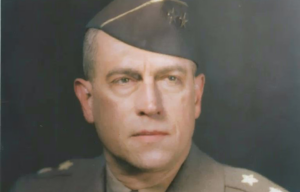
Maurice Rose was born to serve

Maurice Rose’s service during World War I

Maurice Rose’s division completed additional training in Europe before taking up position near Metz, preparing for the Meuse-Argonne Offensive. During a German artillery barrage, Rose was hit by shrapnel, suffering injuries. Although he experienced a concussion, he refused evacuation. Eventually, he was removed from the field after collapsing from exhaustion.
After only a few days in the hospital, Rose departed against medical advice to rejoin his unit. Medical officials, unsure of his location, mistakenly marked him as killed in action (KIA) and sent a letter to his parents reporting his death. This error was corrected once Rose was located.
Rose continued to serve with the 353rd Infantry Regiment for the remainder of the war and remained in Germany following the Armistice. He returned home in 1919 and worked as a traveling salesman until he was recalled to active duty as a first lieutenant. The following day, he was promoted to captain, serving with several regiments at Fort Douglas, Utah, before becoming the adjutant of the 38th Infantry.
Throughout the 1920s and early 1930s, Rose served as an instructor for the Reserve Officers’ Training Corps and the New Mexico National Guard. He was promoted to major in 1936, and in 1939, he was assigned to Fort George G. Meade, Maryland, as an instructor at the Third Corps Area Command and Staff School.
Rising up the military ladder during World War II

Maurice Rose was stationed at Fort Knox, Kentucky when the United States entered the Second World War in 1941. Promoted to lieutenant colonel, he commanded the 3rd Battalion, 13th Armored Regiment, before assuming the role of executive officer of the 1st Armored Brigade, 1st Armored Division. A newspaper reporter spotted Rose during brigade training and dubbed him as “probably the best-looking man in the army.”
In 1942, Rose deployed to North Africa with the 2nd Armored Division and quickly rose to the rank of colonel. The Americans achieved victory over German forces in Tunisia, where Rose played a significant role in negotiating the terms of the German unconditional surrender alongside Generalmajor Fritz Krause.
Rose achieved the rank of major general after Operation Husky

Following the Allied breakout from Operation Overlord, led the 3rd Armored Division into Belgium, where it became the first armored division to cross into Germany, marking a significant achievement on the Western Front. During the Battle of the Bulge, his division was instrumental in halting the German offensive in the Ardennes before resuming its drive toward Cologne.
Maurice Rose’s senseless death

On March 30, 1945, while moving through a wooded area near Paderborn in northeastern Germany, the 3rd Armored Division received reports that German forces were delaying their supporting units. As they attempted to pull back, they were ambushed and encircled by the SS Panzer Brigade Westfalen.
To evade the advancing German troops, Maurice Rose and his men drove their Jeep toward a main road crowded with German Tiger II tanks. The driver tried to maneuver around them, but one tank blocked their way, allowing only the lead Jeep to escape.
Rose and his aide, Maj. Robert Bellinger, exited their Jeep as a German tank commander opened his hatch. With their hands raised, they approached, but the commander aimed a machine pistol at Rose, who was reaching for his holster. A burst of gunfire followed, with 14 rounds striking Rose, killing him instantly.
Bellinger and the others managed to escape and later returned to retrieve Rose’s body. The decorated officer and courageous leader lost his life just months before the war’s end. He was laid to rest at the Netherlands American Cemetery and is remembered as the highest-ranking American killed by enemy fire in Europe during the war.
Rose’s legacy after the war

The sudden death of Maurice Rose deeply affected the U.S. military. U.S. leaders were outraged over the senseless death of such a decorated commander, and a brief investigation was opened to determine if he was the victim of a war crime. However, it was impossible to determine if Rose had been reaching for his pistol to surrender or retaliate. The German tank crew also had no idea he was a high-ranking officer. As such, the case was ultimately dismissed.
Rose’s death also had a profound impact on his family. He was survived by his wife and two sons, both named after him. Maurice “Mike” Rose went on to serve with distinction in World War II, Korea, and Vietnam, while Maurice Roderick “Reece” Rose built a career in law enforcement. Their lives reflected the same values their father stood for—duty, courage under pressure, and dedication to something greater than themselves.