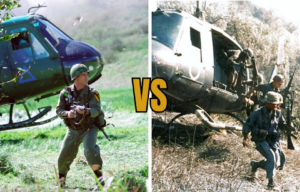

We Were Soldiers is based on the novel, We Were Soldiers Once… and Young: Ia Drang – The Battle That Changed the War in Vietnam, by renowned war correspondent Joe Galloway and Lt. Gen. Hal Moore. Both were present at the Battle of Ia Drang, the first large-scale engagement of the Vietnam War.
The film follows the experiences of both Moore, portrayed by Mel Gibson, and his wife, Julia, played by Madeleine Stowe. The former arrives in Vietnam in November 1965, and, soon after, is tasked with leading his 400 men in an effort to take out the enemy troops who attacked one of the bases in the Ia Drang Valley. Outnumbered when they arrive, the men are forced to fight for their lives while eliminating the 4,000-strong North Vietnamese force.
The secondary plot follows Julia, who volunteers to deliver telegrams informing families of their loved ones’ deaths in Vietnam.
The ending of We Were Soldiers

Battle of Ia Drang

The actual Battle of Ia Drang occurred from November 14-19, 1965, and the intense fighting primarily centered around two key helicopter landing zones: LZ X-Ray and LZ Albany. The 1st Battalion, 7th Cavalry Regiment, under the command of Lt. Col. Hal Moore, was heavily engaged in combat at LZ X-Ray for three days starting on November 14, 1965.
While We Were Soldiers captures much of the battle’s intensity and bravery, the film deviates from the historical facts in its portrayal of the battle’s conclusion. In the movie, the battle ends with Moore’s forces successfully evacuating and completing a dramatic final charge. In reality, however, the battle didn’t officially conclude until LZ Albany was reclaimed by American forces, which marked the true end of the engagement.
Additionally, the majority of the 2nd Battalion, 7th Cavalry Regiment, led by Lt. Col. Robert McDade, didn’t enter the fight until after Moore’s forces had been relieved at LZ X-Ray. After Moore’s men were airlifted out, McDade’s battalion was reinforced by the 2nd Battalion, 5th Cavalry Regiment, and took over the fight to secure LZ Albany.
LZ Albany

The following day, both battalions were alerted that enemy bombers were approaching LZ X-Ray, requiring them to relocate. The 2nd Battalion, 5th Cavalry Regiment advanced toward LZ Columbus, while the 2nd Battalion, 7th Cavalry Regiment moved in the direction of LZ Albany. During the march, they captured two North Vietnamese soldiers, who were interrogated by McDade. He and most of the battalion’s officers and radio operators were then summoned to a briefing to review the intelligence that had been collected.
Meanwhile, the remainder of the 2nd Battalion stayed behind without any means of communication. Exhausted from the fighting at X-Ray, the troops were caught off guard when hundreds of North Vietnamese soldiers infiltrated the area undetected and launched an attack. The battalion en route to LZ Columbus was quickly informed of the fighting, prompting Bravo Company to reverse course and reinforce LZ Albany. Their arrival helped drive back the attackers and allowed the wounded to be evacuated.
Conclusion of the Battle of Ia Drang

There were no further attacks overnight. On November 18, 1965, the US forces were able to gather their dead. Although the fighting had ended, the Battle of Ia Drang didn’t officially conclude until the next day, as it took two days to collect the bodies.
James Lawrence, one of the men who fought at LZ Albany, later recounted his experiences. He wanted to ensure the memories of those who died live on, in particular that of his best friend, Lt. Don Cornett.
Recalling the aftermath of the fight, he said, “Back then Stars and Stripes would carry the casualty reports and I had a red pen and started checking off the names of guys I knew who were listed as KIA. I marked off 65 names and that’s when it really hit me what had happened and it just overwhelmed me. I couldn’t grasp it.”
More from us: Val Kilmer Accidentally Landed Matthew Modine the Starring Role in ‘Full Metal Jacket’
Although it was left out of We Were Soldiers, Albany was no less bloody than X-Ray. Of the 500 men present as part of the 2nd Battalion, 7th Cavalry Regiment, 155 lost their lives, and just 84 were immediately able to return to active duty.