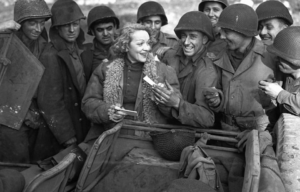
Refusing to star in German propaganda films

In the years before the Second World War erupted, senior Nazi figures reportedly tried to entice Marlene Dietrich to return to Germany, hoping to exploit her global stardom as a propaganda asset. Dietrich flatly rejected these approaches, a decision that allegedly infuriated the Führer, who is said to have viewed her simultaneously as a powerful symbol for the regime and a personal fixation.
Her defiance quickly placed her in the regime’s crosshairs. Accused of associating with Jews, she saw her films outlawed in Germany, and officials ordered the destruction of all copies of The Blue Angel—the very movie that had made her famous. In a bitter contradiction, the Führer reportedly kept a personal copy, claiming it as one of his favorite films.
By 1939, Dietrich took her opposition even further by giving up her German citizenship and becoming an American. Branded a traitor by the Reich, she openly denounced Nazism, once dismissing the Führer as “an idiot.” Through these unwavering acts of resistance, Dietrich cemented her reputation not only as a cinematic icon, but as a figure of moral courage who stood firmly against tyranny.
Marlene Dietrich promoted the sale of war bonds

When the United States entered World War II after the Japanese attack on Pearl Harbor, Marlene Dietrich immediately threw herself into doing whatever she could for the war effort. She was one of the first celebrities to go on a war bond tour, appearing before an estimated 250,000 American troops during the Pacific leg of her trek alone.
Dietrich toured the country from January 1942 to September ’43, with it estimated she alone raised over $1 million. She also sold the most war bonds out of any other Hollywood celebrity – an impressive feat.
J. Edgar Hoover’s suspicions…

Although Marlene Dietrich made her disdain for the Nazi regime well known, her loyalty was still questioned by some in the United States. Suspicion peaked when she submitted an immigration request on behalf of her French partner, actor Jean Gabin. The application caught the attention of Federal Bureau of Investigation (FBI) Director J. Edgar Hoover, who feared it might signal deeper ties to foreign operatives.
Between 1942 and 1944, the FBI launched a quiet investigation into Dietrich’s activities. Agents tailed her closely—tapping phone lines, reviewing her correspondence, and compiling extensive files in search of any disloyal conduct. But their efforts turned up no evidence of espionage. Instead, the investigation mostly revealed information about her personal affairs—provocative at times, but unrelated to national security.
Ironically, while Hoover remained wary, Dietrich was eventually recruited and became a spy for the U.S. government. As a special services contact, she discreetly gathered information about suspicious individuals and potential threats while on USO tours in Europe. Her undercover efforts only deepened her contributions to the Allied cause, reinforcing her dual legacy as both a beloved film star and a quiet warrior in the shadows of World War II.
Marlene Dietrich toured with the USO

Marlene Dietrich was one of the most loved performers with the United Service Organizations during World War II. She toured extensively across the European Theater, bringing entertainment to troops in North Africa, Italy, France, the Netherlands, and the United Kingdom. She even ventured into her native Germany with Gen. George Patton and James M. Gavin!
Dietrich’s performances blended comedy, singing, and dancing, which were greatly appreciated by the troops. She was also known for her skill with the musical saw and often included a “mind reading” act, a trick she learned from actor and director Orson Welles. Her shows were a huge success, with Dietrich receiving up to 1,000 letters daily at one point.
Throughout the war, Dietrich is estimated to have performed an estimated 500 shows, despite battling frostbite and the flu. When asked what motivated her to keep up such a demanding schedule, she simply answered, “Out of decency.” Among all the service members she entertained, the 82nd Airborne Division held a particularly special place in her heart.
Recruited by the Office of Strategic Services (OSS)

In 1943, Marlene Dietrich was one of the celebrities approached by the Office of Strategic Services (OSS) to participate in the MUZAK Project. Spearheaded by the Morale Operations (MO) Branch, the program aimed to lower morale among the enemy through radio broadcasts that smeared the German regime.
Dietrich rerecorded American songs in German, with her most popular track being “Lili Marlene.” While high-ranking officials in Germany tried to get these so-called “black” radio broadcasts banned, they were met with pushback from troops on the front, who actually petitioned that Dietrich’s music be allowed to air.
Along with singing, the actor also hosted a number of broadcasts, in which she urged the Axis soldiers who were listening to not “sacrifice” themselves, as “the war is crap.” Her efforts and that of others, including Bing Crosby and Dinah Shore, were a major success, with both military personnel and civilians alike beginning to question the propaganda they were fed – the US Strategic Bombing Survey even concluded that “the programs were just a devastating to German morale as an air raid.”
For her efforts with the OSS, Dietrich received a personal thanks from Maj. Gen. William “Wild Bill” Donovan, who said, “I am personally deeply grateful for your generosity in making these recordings for us.”
How else did Marlene Dietrich get involved in the war effort?

Now, you might be thinking that there’s no way Marlene Dietrich could have done much more to support the war effort, but you’d be wrong. She was a frequent volunteer at the Hollywood Canteen, a club started by Bette Davis and John Garfield to feed troops, and she also made sure to visit injured service members in hospital when overseas.
Dietrich was also very passionate about supporting the Jewish population and German dissidents. Along with filmmaker Billy Wilder, she set up a fund to help Jews escape Germany, donating her $450,000 salary from 1937’s Knight Without Armour to keep it topped up. She also housed German and French exiles, providing them with financial support and advocating on their behalf for American citizenship.
However, all this wasn’t enough for Dietrich. She felt she could be doing more and thus approached fellow actor and US Navy Capt. Douglas Fairbanks, Jr. about a possible assassination plot against the Führer. Dietrich said she would agree to film one movie for the regime, on the condition she was able to be alone with Germany’s leader, at which point she would kill him. She, however, wasn’t sure how to smuggle in the murder weapon, causing the plan to fizzle out before it could be enacted.
More from us: Did You Know the Last Ever US Cavalry Charge Into Combat Occurred in World War II?
For her dedication to the war effort, Dietrich was awarded a host of honors, including the Presidential Medal of Freedom, which she called her proudest achievement. She also received the French Legion d’Honneur and Belgium’s Knight Order of Leopold.