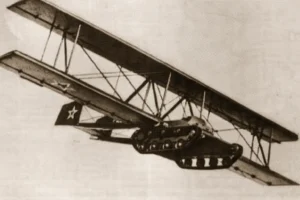
Modern military logistics rely on massive cargo planes like the C-17 to transport armor, but in 1942, the Soviet Union attempted something far more daring. Long before Hollywood began dropping tanks out of airplanes with parachutes, Soviet engineer Oleg Antonov decided to simply give the tank wings.
The result was the Antonov A-40, known as the Krylya Tanka (“Tank Wings”). It remains one of the most audacious experiments in the history of mechanized warfare—a machine that blurred the line between a heavy glider and an armored vanguard.
The Tactical “Why”: Armor for the Airborne

By 1942, the Eastern Front was a brutal, fast-moving theater. While the Soviet Union had pioneered large-scale paratrooper drops, these airborne units faced a recurring nightmare: once they hit the ground, they were light infantry facing German Panzers. They needed “teeth.”
The goal of the A-40 was to provide immediate armored support. Instead of waiting for slow-moving ground reinforcements, paratroopers would literally have a tank glide into the landing zone alongside them.
The Platform: The T-60 Light Tank
To make the concept work, Antonov chose the T-60 light tank. Even as a “light” vehicle, it was an engineering headache for aviation.
- Weight Reduction: To get the A-40 off the ground, the tank had to be stripped of its ammunition, most of its fuel, its headlights, and even its tools.
- The Glider Frame: Antonov designed a massive wooden biplane wing and twin tail assembly that attached directly to the hull of the T-60.
- The Pilot: The “pilot” wasn’t an airman; he was a tank commander who controlled the glider’s rudders and flaps using the tank’s existing steering levers.
The 1942 Test Flight: A Successful Failure

In September 1942, the A-40 was ready for its maiden flight. The legendary Soviet test pilot Sergey Anokhin sat in the driver’s seat of the tank. A heavily modified Tupolev TB-3 bomber acted as the “tug” aircraft.
The takeoff was successful, but the physics of the “flying tank” proved nearly catastrophic.
- Drag and Resistance: The enormous aerodynamic drag of the tank’s boxy shape caused the TB-3’s engines to overheat almost immediately.
- Emergency Release: Fearing the bomber would stall and crash, the pilot was forced to release the A-40 much earlier than planned.
Remarkably, Anokhin successfully glided the tank down to a smooth landing in a field near the Monino airfield. He detached the wings, started the engine, and drove the T-60 back to the base. Technically, the Soviet Union had successfully flown a tank.
Why the “Krylya Tanka” Never Saw Combat

Despite the successful landing, the program was cancelled for a simple, logistical reason: Power. The Soviet Air Force lacked enough high-powered aircraft to tow a combat-ready tank. If the TB-3 struggled with a tank that had no fuel or ammo, it was functionally useless for real-world combat scenarios. By the time more powerful bombers like the Petlyakov Pe-8 were available, the Soviet Union had pivoted toward more efficient ways of delivering heavy equipment, such as massive internal-cargo gliders.
The Legacy of the A-40

The Antonov A-40 is a testament to the “Mad Science” era of WWII engineering. It proved that a tank could fly, but it also proved that in war, logistics dictate the limits of imagination. Today, it serves as a fascinating precursor to modern airborne infantry fighting vehicles (IFVs) like the BMD-1, which are dropped via sophisticated parachute systems.