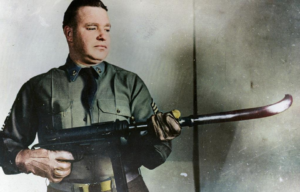
The German Army’s hopes for the Krummlauf

The Krummlauf was developed in 1943 as part of the German Army’s effort to create a rifle attachment capable of bending a bullet’s path. Early prototypes were rudimentary, including experiments like attaching a 20 mm curved barrel to an 8 mm rifle, but engineers gradually developed a functional design.
Built for the MP 44 (StG 44) assault rifle, the Krummlauf featured a sharply angled barrel and a periscopic sight, enabling soldiers to fire around obstacles, into trenches, or from within armored vehicles while remaining protected. German planners had hoped to equip every MP 44 operator with one, anticipating a tactical advantage that could influence the course of the Second World War.
Despite its ingenuity, the Krummlauf’s high barrel stress, short operational lifespan, and erratic accuracy prevented it from becoming the revolutionary weapon Germany had envisioned.
Use by German infantrymen

The infantry version of the Krummlauf, known as the “I” variant, measured 14 inches in length and included a 30-degree bend in its barrel. Its design consisted of a four-inch straight barrel segment, a five-and-a-half-inch curved section, and a final four-and-a-half-inch straight portion. In addition to being compatible with the StG 44, it could also be fitted to the MG 42.
A mirror was used to let operators see where they were aiming

The version designed for infantry featured a mirror that enabled the operator to clearly see their target without exposing their position. According to The Armory Life, “Using the curved barrel, a German gunner would be at least 20 cm below the edge of his foxhole or whatever cover he was using.”
The design also allowed for a cheek weld stance, thanks to a front sight mounted at the end of the Krummlauf, along with a rear sight positioned behind the mirror.
Equipped by the Elefant tank destroyer

The tank-mounted Krummlauf was manufactured in four bend configurations: 30°, 45°, 60°, and a 90° version designated the “Versatz P.” Unlike the other models, the 90-degree attachment was oriented upward, making it particularly suitable for use inside the restricted interior space of armored fighting vehicles. It was fitted to a rounded steel mounting block through a cup-shaped coupling that kept the curved barrel correctly aligned with the vehicle’s firing aperture.
Designed mainly for the Elefant tank destroyer, this variant saw a production run of about 500 units. To support accurate targeting, approximately 1,500 specially designed sighting devices were also manufactured for crew use.
Problems with the Krummlauf

After World War II, the U.S. military acquired a Krummlauf and conducted trials at Aberdeen Proving Ground. The results showed the device was essentially a failure and structurally weak. While designers had estimated it could withstand up to 6,000 rounds, testing told a different story—the 30-degree version failed after about 300 shots, and the 45-degree model lasted only around 160 rounds before breaking down.
More from us: The Mosin-Nagant Has Seen Over a Century of Service
Firing a round through the Krummlauf generated intense friction, producing extreme heat that often caused the bullet to fragment before exiting the barrel. Instead of traveling as a single, intact projectile, it broke apart into multiple pieces, creating a spread more comparable to a shotgun blast. This greatly reduced accuracy and confined the attachment’s practical use to very short distances.