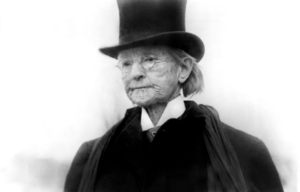
In the United States today, women make up roughly a third of all physicians and about 14 percent of active-duty service members—a reality that would have been almost unthinkable in the 19th century. Born in 1832, Mary Edwards Walker defied the strict expectations of her time to become the U.S. Army’s first female surgeon.
Mary Edwards Walker’s upbringing
Mary Edwards Walker was raised in Oswego, New York, in a household deeply influenced by her abolitionist parents. From childhood, they fostered independent thinking and encouraged her to challenge societal norms. She frequently defied traditional women’s fashions, enduring criticism and social pushback for her unconventional style.
Biographer Sharon Harris said of Walker’s childhood, “Boys chased her and threw rocks at her. She once said that nobody would ever know what she had to go through just to step out the door each morning.”

Mary Edwards Walker’s parents insisted she have access to the same rigorous education as her brothers. She began her studies at a free public school founded by her family, which provided a solid academic foundation. Later, she attended Falley Seminary, a school known for both its advanced curriculum and its progressive stance on social reforms and women’s roles.
Her time at Falley Seminary profoundly influenced her, strengthening her belief in equality and inspiring her lifelong determination to defy societal norms.
Walker’s medical career
In the middle of the 19th century, women faced significant challenges when trying to enter the medical profession. Restrictive social norms, unequal educational opportunities, and entrenched discrimination made it extremely difficult for aspiring female physicians to receive the training and qualifications they needed.
Even with those barriers in place, Mary Edwards Walker attended Syracuse Medical School in New York, where she excelled academically and graduated with honors in 1855. While studying there, she met fellow medical student Albert Miller, whom she eventually married, creating a partnership that reinforced her resolve to break through the obstacles facing women in medicine.

Influenced by the principles instilled by her parents, Walker promoted clothing that prioritized health, comfort, and practicality over fashion and societal expectations. In 1871, she wrote, “The greatest sorrows from which women suffer today are those physical, moral, and mental ones, that are caused by their unhygienic manner of dressing.”
American Civil War
When the American Civil War began, Walker was determined to contribute to the Union cause. She had already operated a private medical practice for several years and volunteered to join the Union Army as a surgeon, but her request was initially denied. Instead, she was offered work as a nurse, a role she accepted before eventually being permitted to serve as a surgeon.

In 1862, Walker proposed serving as a spy, but the offer was rejected. The following year, she became the first woman to serve as a U.S. Army surgeon. In 1864, the Confederate Army captured her after she assisted a Confederate physician with an amputation. Walker remained a prisoner for about four months before being released in a prisoner exchange for a Confederate surgeon.
Medal of Honor controversy

Mary Edwards Walker’s legacy
Mary Edwards Walker left her mark on the country in a variety of ways. While they struggled to earn respect, women served as doctors during World War I. Over time, women began to serve in the military, not just as nurses and doctors, but as soldiers, too.

Walker was inducted into the Women’s Hall of Fame in 2000. A World War II-era ship, the SS Mary Walker, was named in her honor. A number of medical and military buildings are also named for her. In 2009, Hillary and Chelsea Clinton featured her story in The Book of Gutsy Women: Favorite Stories of Courage and Resilience.