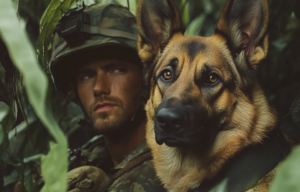
Not the first war dogs

Dogs have long played a role in warfare, but it wasn’t until World War II that the U.S. began officially training dogs for combat duties. Between 1943 and 1945, the Marine Corps began preparing dogs—especially Doberman Pinschers—for service in the Pacific, where they took on crucial responsibilities like carrying messages and guarding camps. Their effectiveness on the battlefield quickly earned them a place as essential military assets.
Use as tracking dogs in Vietnam

Labrador Retrievers were one of the dog breeds used in Vietnam, mainly for tracking. They were trained to alert their handlers to snipers, tripwires, and hidden weapons. Vietnam War veteran Rick Claggett explained that they were especially good at following blood trails. A typical Lab team was made up of the dog, its handler, a cover man, the team leader, and a visual tracker, and they were sent out when troops needed to find a wounded enemy or a missing person.
Labradors were chosen over other breeds like Beagles and Bloodhounds because they made less noise.
In Australia, K9 units were created using 11 shelter dogs adopted from Sydney. These dogs were named after Roman emperors and were expected to serve in Vietnam for three years. While they sometimes worked with American troops, the main breed used by the Australians was the German Shepherd.
Sentry and scouting duties

During the Vietnam War, military working dogs proved highly adaptable, performing critical duties that included guarding, reconnaissance, mine detection, tunnel operations, and tracking. Rick Claggett, who partnered with a trained scout dog named Big Boy, explained that their main responsibility was to lead patrols across open terrain. Positioned at the front of these missions, the dogs relied on their ability to detect booby traps and potential ambushes through scent, making the job especially hazardous. Claggett noted that this assignment had the third-highest death rate of any role during the war.
Sentry dogs were stationed around the edges of U.S. bases, serving as an early warning system against approaching enemy troops. German Shepherds also took part in water patrols, using their sharp senses to locate enemy fighters hidden beneath the water and waiting to strike amphibious vessels. Because these dog-handler teams were so effective, they became prime targets for Viet Cong guerrilla forces, who placed rewards on both the animals and their handlers and even raided kennels in an effort to collect the bounties.
Nemo A534

Man’s best friend

These dog/handler teams were invaluable to the war effort in Vietnam. They were credited with saving the lives of around 10,000 servicemen, thanks to their various roles in the conflict. James Mulligan handled scout dog Rickey, who “never walked our patrol into an ambush or any booby traps. He alerted on 45 ambushes, five in one day.”
While these actions were appreciated by the men who served alongside them, these dogs weren’t made a priority when the war came to an end. Of the roughly 5,000 that served, around 232 were killed in action (KIA) and another 200 were assigned to posts outside of the US. The remainder were either left in the hands of the Vietnamese or abandoned. At least 2,000 were simply euthanized.
The US government viewed them as “equipment” and didn’t want to fund their trips home. Having built such strong bonds, many soldiers wanted to bring their comrades back to the US with them, but were still told no, despite repeated appeals to Congress and the press.
More from us: Battle of Khe Sanh: The Siege That Shook America
The service performed by these canines never went forgotten, and there are countless interviews with veteran handlers who still remember their partnerships fondly. In 2019, they were publicly remembered when the Vietnam War Dog Team Memorial was unveiled at Motts Military Museum, Inc. in Ohio.