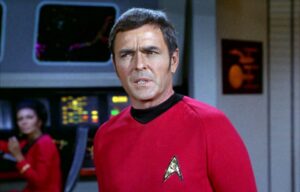
James Doohan, a World War II veteran, used his bravery and service as a stepping stone to a successful acting career that would go on to inspire many future engineers. His achievements even influenced an astronaut who later walked on the moon. Although he wasn’t actually Scottish, Doohan mastered the iconic accent, securing his place as one of the most respected military veterans to transition into television stardom.
James Doohan’s entry into the Canadian Army

James Montgomery “Jimmy” Doohan was born on March 3, 1920, in Vancouver, British Columbia, the son of Irish immigrants. His father, William, was a pharmacist who was said to have developed a high-octane fuel in 1923, although this account has never been verified. Regardless, Doohan was raised in a household where science and technological advancement were highly valued.
Following his family’s relocation to Ontario, Doohan attended Sarnia Collegiate Institute and Technical School and demonstrated particular talent in mathematics and science. In 1938, he became a member of the 102nd Royal Canadian Army Cadet Corps. He subsequently served with the 14th (Midland) Field Battery of the Royal Canadian Artillery, which belonged to the 2nd Canadian Infantry Division.
Doohan’s capabilities eventually led to his commissioning as a lieutenant in the 22nd Field Battery, 13th Field Artillery Regiment, of the 3rd Canadian Infantry Division. After receiving his commission, he went to England for additional military training.
Preparing to land at Juno Beach

On June 6, 1944— D-Day— British, American, and Canadian troops each had designated landing areas along the Normandy coast. The Canadians were responsible for taking control of Juno Beach, a section of shoreline between Courseulles-sur-Mer and Saint-Aubin-sur-Mer.
James Doohan’s unit faced a tough challenge as they moved west of Caen, where they encountered two battalions from the German 716th Infantry Division and heavily fortified positions from the 21st Panzer Division. Adding to the danger, the beaches were heavily mined with anti-tank explosives.
The night before the invasion, Allied aircraft bombed German defenses to weaken them before the Canadians launched their attack early in the morning under the cover of darkness. However, poor weather and low visibility made the bombings less effective, leaving much of Juno Beach’s defenses intact.
James Doohan took out two German snipers on D-Day

It got worse. Rough weather and high waves delayed the landings until well after the sun had risen on June 6, 1944. Out at sea, James Doohan felt queasy, but it wasn’t because of what lay ahead. He later told the Associated Press, “We were more afraid of drowning than [we were of] the Germans.”
Once the risk of drowning was behind them, what lay ahead for the Canadians proved to be much worse. The first group reached Juno Beach at 7:35 AM and were quickly cut down.
Fortunately for them, the light cruiser HMS Ajax (22) had bombarded Juno Beach earlier, doing more damage to the coastal defenses than the aircraft had. After two hours, the Canadians had swept aside most of the Germans along their stretch of the beach. Doohan led his men across the sands and got lucky, as none of the anti-tank mines went off, as the men weren’t heavy enough to activate them.
As they made their way to higher ground, Doohan shot two German snipers – his first kills of the war. By noon, they’d secured their positions. However, they now had a new problem. The beach was so thick with Canadians that the later arrivals couldn’t advance. As darkness fell, there was a risk they’d mistake comrades for the enemy and end up shooting at each other.
This was exactly what happened, not only at Juno Beach, but at the other landing beaches.
James Doohan suffered six bullet wounds

At about 11:20 p.m., James Doohan wrapped up a smoke break and reassuringly patted the cigarette case in his shirt pocket. The case, a gift from his brother, was something he regarded as a good-luck charm. Moments later, while making his way back to his command post, Doohan was caught in a burst of gunfire from a Bren light machine gun. Four bullets struck him in the leg, another hit him in the chest, and a sixth took off his right middle finger.
The gunfire had not come from a German sniper, but from an overzealous Canadian sentry. Doohan survived the shot to his chest because the bullet struck his cigarette case, which stopped it from causing a potentially fatal wound. Years later, the actor joked about the incident, saying it was the one occasion when smoking had actually saved his life.
‘Craziest pilot in the Canadian Air Force’

After recovering from his injuries, James Doohan learned to fly a Taylorcraft Auster Mark IV for the No. 666 Squadron RAF. By this point, he was an officer in the Royal Canadian Artillery, supporting the 1st Army Group Royal Artillery at RAF Andover, Hampshire.
In early 1945, Doohan flew his aircraft between two telegraph poles, just to prove it could be done. He got in trouble for that, and everyone called him the “craziest pilot in the Canadian Air Force.”
James Doohan goes from the Canadian Army to outer space

After the Second World War, James Doohan returned to Canada. Upon hearing a radio drama, he believed he could do a better job than the voice actors featured and switched his focus of study from technical schooling to drama. His first job was with CBC radio. He ultimately went on to do 4,000 shows on radio and 450 on television, earning a reputation as the most versatile voice actor in the business.
In 1965, Doohan was assured of a place in film history when he landed – and helped develop – the role of Montgomery “Scotty” Scott in Star Trek. In addition to playing the role of chief engineer for the starship Enterprise, Doohan also helped create the Klingon and Vulcan languages for the show.
Doohan became so iconic that fans credited him with their interest in engineering, astronomy and other technical fields. Among these was the engineer-turned-astronaut Neil Armstrong, who personally thanked Doohan in 2004.
More from us: Star Trek Creator Gene Roddenberry Faced Death Twice While In the US Army Air Forces
Doohan died in 2005. To honor him, a Falcon 9 launch vehicle took some of his ashes into space. Two years later, the Scottish town of Linlithgow claimed him as one of their own with a predictive commemorative plaque. “Predictive” because it claims he will be born there on 2222.