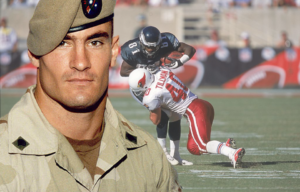

Pat Tillman was born on November 6, 1976, in Fremont, California, and demonstrated exceptional athletic talent from a young age. Excelling in football, he helped lead his high school team to a Central Coast Division I Football Championship, earning him a scholarship to Arizona State University (ASU).
At ASU, Tillman became a key contributor to the Sun Devils’ success, playing a major role in their undefeated season and Rose Bowl appearance. Over three years, he was recognized as ASU’s MVP and named the Pac-10 Defensive Player of the Year. His standout college career led to his selection by the Arizona Cardinals as the 226th overall pick in the 1998 NFL Draft.
During his tenure with the Cardinals, Tillman had a number of accomplishments. He started 10 of 16 games as a rookie and, across 60 games, accumulated 340 tackles, 15 pass deflections, three forced fumbles, and three fumble recoveries.
Despite a promising NFL career, Tillman’s priorities shifted after the September 11th attacks. In May 2002, rather than re-signing with the Cardinals, he and his brother Kevin enlisted in the U.S. Army, choosing service to their country over professional football.
Becoming a US Army Ranger

During their time in the Army, Pat and Kevin Tillman completed basic training before entering the Ranger Assessment and Selection Program (RASP). Both successfully passed and were assigned to the 2nd Ranger Battalion at Fort Lewis, Washington. While Pat initially hoped to be deployed to Afghanistan, he and his brother were instead sent to Iraq.
Those close to Pat noted that he was critical of the U.S. invasion of Iraq, with some recalling that he referred to the war as “illegal.” Despite his concerns, he remained committed to his service.
After returning to the U.S., Pat and Kevin attended Ranger School at Fort Benning (now Fort Moore) in Georgia. A few months after graduating, they were sent to Afghanistan, where they were stationed at Forward Operating Base (FOB) Salerno.
Pat Tillman loses his life in Afghanistan

“Caught between the crossfire of an enemy near ambush, Corporal Tillman put himself in the line of devastating enemy fire as he maneuvered his fire team to a covered position where they could effectively employ their weapons on known enemy positions. His audacious leadership and courageous example under fire inspired his men to fight at great risk to their own personal safety.”
Investigations force US Army officials to reveal the truth

As previously mentioned, the account provided by the US Army did not accurately explain the circumstances of Pat Tillman’s death. In reality, he was killed by friendly fire, a fact known to the service within 24 hours due to an investigation conducted by an officer in his battalion. However, it took five weeks before officials publicly acknowledged that the Ranger had been killed by gunfire from his fellow soldiers.
A study of the autopsy report, conducted more than two years after Tillman’s death, suggested he was likely shot three times in the head with an M249 light machine gun, which uses the same caliber rounds as the M16 rifle and M4 carbine.
Investigations into Tillman’s death were led by the Department of Defense, Brig. Gen. Gary M. Jones, and the Army’s Criminal Investigative Division (CID). In addition, members of his unit testified before the House Committee on Oversight and Government Reform. Spc. Bryan O’Neal, the last person to see him alive, later revealed that he had been instructed by his superiors not to discuss what had actually happened, particularly with Tillman’s family.
None of the investigations found enough evidence to support the theory that Tillman had been killed by enemy fire. All signs pointed to the tragic incident being caused by an American serviceman.
What did the investigations reveal about Pat Tillman’s death?

It’s one thing to know that the subsequent investigations found Pat Tillman was killed by friendly fire and another to know what they found. The one by Brig. Gen. Gary M. Jones caused the most uproar, as it was among the first to share what occurred on April 22, 2004.
Along with being shot three times in the head, Jones’ investigation uncovered that the bullets had come from just 10 yards away, meaning the individual who’d pulled the trigger was standing relatively close to Tillman. Jones also found that Lt. Gen. Stanley McChrystal, who’d approved the fallen Ranger’s Silver Star, had sent out a memo warning Army officials that his death may have been the result of friendly fire.
Among the most damning evidence uncovered by Jones was that Tillman’s comrades took his body armor, uniform and notebook and set them ablaze in an attempt to hide what had happened. Those involved were later punished for their actions.
While the Pentagon agreed that Tillman had ultimately fallen victim to friendly fire, officials continued to state the incident occurred under a flurry of enemy gunfire. They claimed that, despite attempts by Tillman and his fellow Rangers to identify themselves as friendlies to their comrades, they were mistaken for militants and shot at.
However, documents released through a Freedom of Information Act request by the Associated Press showed that no evidence of enemy fire was found at the scene, nor did any of Tillman’s comrades show signs of having engaged in a firefight. They also revealed that Army doctors had told investigators that his death should be considered a murder, as the “medical evidence did not match up with the scenario as described.”
Reaction to the alleged US Army coverup

Pat Tillman’s parents reacted with anger after eventually discovering the true circumstances of their son’s death. His family did not learn that he had died from friendly fire until several weeks after a heavily attended memorial service at which Arizona Senator John McCain delivered the eulogy.
After the truth emerged, Tillman’s parents openly condemned the U.S. Army, alleging that officials had manipulated the account of his death to portray him as a symbolic figure and bolster public backing for the wars in Afghanistan and Iraq. His father, Patrick Tillman, maintained that military leaders intentionally concealed what happened out of concern that the truth could hurt recruitment, while his mother, Mary Tillman, believed the Army’s primary motivation was preserving its public reputation.
Pat Tillman’s legacy

Immediately following Pat Tillman’s death, the Arizona Cardinals retired the number 40, which he’d worn during his time with the team. The Sun Devils at Arizona State University also retired his number 42. Both have also created permanent memorials to Tillman. The plaza surrounding the stadium where the Cardinals play was renamed the Pat Tillman Plaza, while parts of ASU have been renamed for him.
Tillman’s family and friends have since established the Pat Tillman Foundation, which aims to promote positive change in the world and holds an annual fundraiser in the fallen Ranger’s name. On top of this, he was also posthumously inducted into the College Football and Arizona Sports Halls of Fame.
The NFL has also done its part to honor Tillman’s legacy. In 2004, the league donated $250,000 to the USO to establish the Pat Tillman USO Center at Bagram Airfield. The center, unveiled in April 2005, was the first of its kind to be erected in Afghanistan.
More from us: NFL Players Who Lost Their Lives Serving in the US Military
However, not everyone has been happy with how the NFL has covered Tillman’s passing. Following Super Bowl LVII in February 2023, many took to social media to criticize the league for its tribute to him during the game. According to many, important parts of the story were left out of the coverage.