The year was 1797. Revolutionary France was on a roll, Napoleon was carving through Europe, and a bold plan was hatched to strike the “Shopkeepers of England” directly on their own soil. It was to be a grand, three-pronged invasion that would bring Britain to its knees.
Instead, the Battle of Fishguard became one of the most embarrassing military fiascoes in history. The French “Black Legion” didn’t fall to the British Army; they fell to a shipwrecked cargo of wine and a group of local women in red shawls.
The “Black Legion”: An Army of Convicts

The invasion was led by an Irish-American veteran of the Revolutionary War, Colonel William Tate. His force, known as the Légion Noire (Black Legion), consisted of over 1,000 men. However, only 600 were professional soldiers. The remaining were convicts and “irregulars” swept from French prisons.
The plan was for Tate to land in Wales, burn Bristol, and incite a peasant uprising against the British Crown. On February 22, 1797, Tate’s four-ship fleet dropped anchor at Carregwastad Point.
The Wine That Saved Wales

Almost the moment the French stepped onto Welsh soil, the invasion began to dissolve. The convicts, cold and hungry, were less interested in revolution and more interested in looting.
Fortunately for the British, a Portuguese merchant ship had recently wrecked nearby. Its entire cargo of wine had been salvaged and stored in local farmhouses. The French soldiers discovered the stash and immediately abandoned their posts. Within 24 hours, the majority of the “invasion force” was either incapacitated, passed out, or wandering the countryside in a drunken stupor.
The Secret Weapon: Welsh Women in Red

While the French were busy looting, the British scrambled to put together a defense. Lord Cawdor managed to assemble a patchwork force of roughly 600 men—reservists, sailors, and local militia.
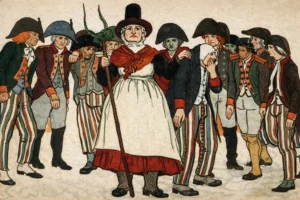
Cawdor knew he was outnumbered, so he turned to psychological warfare. In the distance, hundreds of local Welsh women had gathered on the hills to watch the commotion. They were dressed in traditional Welsh costume: tall black hats and red flannel shawls.
From a distance, the red shawls looked identical to the iconic “Redcoats” of the British Regular Army. Cawdor marched his small group of soldiers in circles, and the women joined in, creating the illusion of a massive British force arriving as reinforcements.
Jemima Nicholas: The Pitchfork Heroine

The most famous figure of the battle wasn’t a soldier, but a 47-year-old cobbler named Jemima Nicholas. Armed with nothing but a pitchfork, she marched out into the fields and single-handedly rounded up twelve French soldiers who were too drunk or too startled to resist. She marched them back to town and locked them in the local church.
The Unconditional Surrender

By February 24, Colonel Tate was convinced he was facing thousands of elite British troops. With his own men either mutinous or drunk, he sent envoys to negotiate a surrender.
Lord Cawdor bluffed, demanding an unconditional surrender and claiming his “force” (which was mostly women and a few militiamen) would attack at 10:00 AM the next day. Tate folded. The “Last Invasion of Britain” ended at the Royal Oak Inn, where Tate signed the surrender documents.