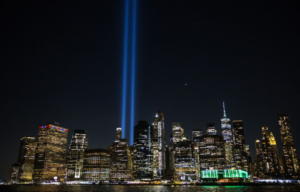
For many people around the world, September 11, 2001 remains an unforgettable day defined by tragedy, loss, and profound upheaval. Although the site of the World Trade Center has been rebuilt, the field in Shanksville has largely returned to its quiet rural landscape, and the Pentagon has been repaired, the impact of the attacks continues to be felt across the world.
Below are nine key facts about the September 11 attacks.
Ground Zero

You’ve likely seen the image of firefighters raising the American flag at Ground Zero just mere hours after the attack. Today, we commonly refer to the World Trade Center‘s location as “Ground Zero,” but it’s not the first site to carry this designation.
Ground Zero was initially used to describe the locations of atomic bomb detonations, namely the Trinity Test site in New Mexico, Hiroshima and Nagasaki.
Three separate locations were attacked on 9/11

New York City, New York, is what comes to mind when you think of 9/11. This is likely due to the media coverage it received. That being said, there were two other locations that were impacted that day: the Pentagon and a field in Pennsylvania.
United Airlines Flight 93 crashed into a field in Somerset County, Pennsylvania. The hijackers originally intended to crash the airliner into either the White House or the Capitol, but the passengers, having learned of the hijackings in New York, were not about to let that happen – they tried to overtake the aircraft, which led to the aforementioned crash.
The Pentagon was hit at 9:37 AM and suffered severe damage, collapsing in some spots; it took the airliner under a second to penetrate through the building’s rings (about 310 feet in length). The crash sent a fireball into the sky.
An engine from one of the aircrafts survived

Airliners crashed into the Twin Towers. Somehow, between the initial strike, the fires and the eventual collapse of the buildings, an engine from one of them managed to survive. It’s believed to be from United Airlines Flight 175, and it was found blocks from Ground Zero.
$100 million in art was destroyed on 9/11

One thing most people don’t think about when considering the losses incurred on 9/11 is art. Around $110 million in art was destroyed during the attacks, with pieces from the likes of Pablo Picasso and Roy Lichtenstein being lost.
Cantor Fitzgerald

Cantor Fitzgerald, LP, a financial services firm, lost more than two-thirds of its staff on September 11, 2001. Its headquarters occupied floors 101 through 105 of the World Trade Center. The company suffered the largest loss of employees, exceeding any other company, government agency, or organization that was impacted that day. Tragically, none of the Cantor Fitzgerald employees present in the towers survived.
In total, 658 of the firm’s 960 employees perished, representing an unprecedented blow to the company.
Three buildings fell on 9/11

Three buildings collapsed in New York City on September 11, 2001. While most people remember the destruction of the Twin Towers, another structure—7 World Trade Center—also fell later that same day.
The building was severely damaged when debris from the nearby World Trade Center towers struck it after their collapse, igniting fires throughout the structure. After burning for several hours, 7 World Trade Center ultimately collapsed at approximately 5:20 p.m. on September 11. Fortunately, the building had been evacuated earlier in the day, and no fatalities resulted from its collapse during the September 11 attacks.
A horrific death toll

It’s reported that 2,996 people died in the attacks on September 11, 2001: 2,977 victims, as well as 19 hijackers. There were more than 6,000 injuries reported, as well.
Below are the death tolls from each location:
- World Trade Center: 2,606 victims.
- American Airlines Flight 11: 87 victims, five hijackers.
- United Airlines Flight 175: 60 victims, five hijackers.
- Pentagon: 125 victims (civilian, military and government personnel).
- American Airlines Flight 77: 59 victims, five hijackers.
- United Airlines Flight 93: 40 victims, four hijackers.
Economic impact of 9/11

It’s believed planning the attack cost the hijackers over $500,000 to plan and coordinate the attack. In the United States, it cost more than $750 million to clean up Ground Zero, and there was more than $9.3 billion in insurance claims.
On top of this, about $60 billion in damages was suffered by the World Trade Center and New York City’s subway system, and over $120 billion was estimated to have been lost in the airline industry and tourism sector.
Where did the steel from the World Trade Center go?

In total, there was 185,101 tons of steel at the site of the World Trade Center. A majority of this was actually sold following the cleanup of the site. China and India were major buyers, with Chinese company Baowu purchasing more than 50,000 tons.
More from us: Deadly Military Uniform Designs That Ultimately Got Soldiers Killed
Any unsold steel was later be used to erect memorials across the United States, with some being included in the construction of the USS New York (LPD-21).