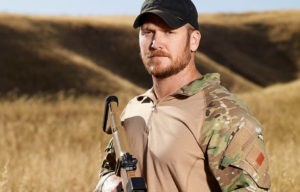
Chris Kyle rose to prominence as one of the most lethal and accomplished snipers in U.S. military history. Over four tours in Iraq, his pinpoint accuracy and unwavering dedication to safeguarding fellow service members earned him the nickname “American Sniper,” symbolizing both the valor and complexity of the modern American soldier.
After leaving combat, Kyle faced the difficult transition to civilian life. He turned his experiences into a memoir, offering an unflinching account of the toll war takes—both in combat zones and on home soil. The book became a bestseller and was later adapted into the 2014 film American Sniper, directed by Clint Eastwood, bringing his story to a global audience.
Tragically, in 2013, Kyle and a friend were killed while trying to assist a fellow veteran struggling with post-traumatic stress. His death represented not only the loss of a remarkable soldier but also of someone devoted to helping others navigate life after service, leaving behind a legacy that extended far beyond his battlefield accomplishments.
Chris Kyle’s early life

Chris Kyle was born on April 8, 1974, in Odessa, Texas, and spent his formative years on a ranch, embracing the rugged lifestyle of rural Texas. At eight years old, his father gave him a .30-06 Springfield rifle, sparking a lifelong fascination with firearms.
Training to be a US Navy SEAL

Chris Kyle joined the US Navy in 1998. Although he had originally considered the US Marine Corps, he was persuaded by a Navy recruiter to try out for the SEALs program, despite his reservations about the pins in his arm from a previous rodeo injury.
Kyle started basic training in February 1999 at Naval Station Great Lakes, completing it just a few months later. He then underwent intelligence training. Although initially turned away, he was later selected for the demanding Basic Underwater Demolition/SEAL (BUD/S) training at Naval Amphibious Base Coronado. After successfully making it through the rigorous training, he graduated in March 2001 with Class 233.
Upon graduating, Kyle continued with SEAL Qualification Training (SQT) and was assigned to SEAL Team-3, Sniper Element, Platoon “Charlie.”
Chris Kyle’s service in the Iraq War

Chris Kyle’s service in Iraq began with the 2003 invasion. As part of SEAL Team-3, his role as a sniper proved crucial in several battles, including at al-Faw and the Second Battle of Fallujah. Known for his precision, his reputation grew, with the insurgents he’d been tasked with hunting down dubbing him the “Devil of Ramadi.” They also placed a bounty on his head.
Deployed on four tours, Kyle’s most famous sniper shot occurred during his deployment to Ramadi, where he killed an insurgent from over a mile away. He also used his skills to save ground troops from an individual with a grenade. In what was his first ever long-range kill, he used his .300 Winchester Magnum to make the shot.
His actions were instrumental in protecting the American and allied forces, earning him a Silver Star and four Bronze Stars with “V” devices. He’s since been called the deadliest sniper is US military history, with him placing his personal kill count at 160.
Controversy surrounding American Sniper

In 2012, Chris Kyle released his memoir, American Sniper: The Autobiography of the Most Lethal Sniper in U.S. Military History, which quickly became a bestseller. The book recounted his experiences in Iraq, highlighting the challenges and responsibilities he faced as a sniper.
American Sniper was adapted for the big screen by Clint Eastwood

Chris Kyle’s story reached a wider audience with the 2014 film adaptation of American Sniper. It was directed by the one and only Clint Eastwood, who was drawn to Kyle’s story for its exploration of the personal and professional challenges faced by troops. The film was widely viewed as anti-war, with Eastwood discussing his stance on the wars in Iraq and Afghanistan in a 2015 interview:
“I was not a big fan of going to war in Iraq or Afghanistan, for several reasons, several practical reasons. One, Afghanistan, the British had never been successful there; the Russians had 10 years there and hadn’t been successful […] Iraq, I know, was a different deal, because there was a lot of intelligence that told us that bad things could happen there, and we’re never sure how that ended up, whether it was pro or con. [But] I tend to err on the side of less is best.”
The film was both a commercial success and a subject of debate; it was praised for its portrayal of Kyle’s life, but criticized for its depiction of the Iraq War. Despite differing opinions, it resonated with audiences, earning six Oscar nominations, including Best Picture.
Murder of Chris Kyle and Chad Littlefield

More from us: Michael Conner Humphreys: The Actor Who Played Young Forrest Gump Served In Iraq
Routh was found guilty of murder and sentenced to life in prison without parole.