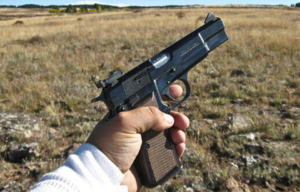
In 2017, the Canadian Armed Forces arrived at the Armed Forces Skill at Arms (AFSAM) competition with 20 Browning Hi-Power pistols—sidearms dating back to the Second World War. Their age showed immediately: during warm-up drills alone, 15 of the pistols broke down, leaving only five still usable.
Throughout the competition, Canada’s ten shooters experienced an average of 4.5 malfunctions each while firing a total of 2,810 rounds. Meanwhile, the British contingent fired 5,620 rounds without a single issue, a stark contrast that highlighted how far behind Canada had fallen. The outcome was an unmistakable embarrassment.
The incident reinforced what many had already believed: the Browning Hi-Power, once a top-tier service pistol, was long past its effective service life. While other nations had moved on to modern, reliable handguns, Canada was still relying on a design approaching its 90th year. Only in 2024 did the Canadian Forces finally replace the Hi-Power with a current-generation service pistol.
Development of the Browning Hi-Power

One of history’s most reliable pistols

Over time, over 50 militaries around the world adopted the Browning Hi-Power as their service pistol, with it considered the most reliable of the era. It was so popular that it became one of the few to be equipped by both the Allied and Axis Powers during World War II and its associated conflicts, including the Winter and Continuation Wars.
Outside of the Second World War, the Hi-Power saw use with elite American units during the Vietnam War, as well as with the French during both the First Indochina War and the Algerian War. The pistol began to fall out of favor in the 1990s, as modern weapons began to show their capabilities, and production was ended in 2017. However, it was restarted in 2022, with upgrades made to the pistol.
Browning Hi-Power and the Canadian Armed Forces

When production of the Browning Hi-Power came to an end, the Canadian military was forced to cannibalize parts from other Browning pistols just to keep damaged handguns in service. With close-quarters fighting making rifles less useful in tight urban battles, troops were left relying on sidearms that could no longer be trusted.
The problem grew so notorious that soldiers joked a well-thrown pistol might do more damage than firing one. Bob Kinch, once a competitive shooter in the Canadian Armed Forces, quipped that although he’d prefer the Browning to a pointed stick, he would still “look fondly” at the stick.
Across the Atlantic, the British Army had held onto their World War II-era Brownings for decades, but eventually acknowledged the danger of clinging to such dated weapons. After trials with modern pistols, they settled on the Glock 17 (Gen 4). By contrast, Canada lagged far behind, taking years longer to move on from the aging Hi-Power.
Why does the Canadian Armed Forces have so many units?

The Browning Hi-Power pistols fielded by the Canadian Armed Forces were manufactured by John Inglis and Company in Toronto, Ontario. They were originally intended to be sold to China as part of the effort to support Chinese forces against Japan during World War II. But Japan surrendered before the shipments were completed, leaving Canada with a large reserve of these sidearms.
The surplus was so substantial that, well into the 2000s, some pistols remained in their factory wrappings—never issued, never handled, and preserved exactly as they had been the day they left the production line.
Pursuing an alternative to the Browning Hi-Power

The Browning Hi-Power is showing its age in other ways, too. There’s no place to mount a flashlight on the original models and the small sights are difficult to aim in low-light conditions. The pistols can’t be fired while wearing gloves or with the left hand, and the long hammer can cut open the shooter’s palm. They’re also pretty heavy, due to their all-metal construction.
The Canadian Armed Forces began looking into purchasing replacement service pistols in the mid-2010s, but the process became bogged down. To fill the gap left by the aging Hi-Powers, the military introduced the Army Interim Pistol Program to purchase around 7,000 pistols. The gun’s successor, the SIG Sauer P320 (designated the C22 in Canada), was chosen in 2022. Units began to be distributed in 2023, with it reported the process was completed the following year.
More from us: Heckler & Koch G3: The Cold War-Era Battle Rifle That’s Stood the Test of Time
As for the Hi-Powers, it’s currently unknown how they’ll be destroyed. It’s been suggested they’ll be smelted, but this hasn’t been confirmed.