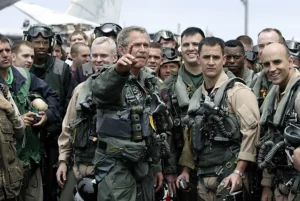
While several U.S. presidents have served in the military, only one has officially broken the sound barrier as a fighter pilot. Before he was the 43rd President, George W. Bush was a lieutenant in the Texas Air National Guard, pulling interceptor alert in one of the most challenging jets of the Cold War: the Convair F-102 Delta Dagger.
Known affectionately (and sometimes derisively) as “The Deuce,” the F-102 was a high-performance interceptor designed for one specific mission: catching and killing Soviet bombers before they could reach American soil.
Breaking Mach 1: The First Supersonic President

Bush joined the 147th Fighter Interceptor Group in 1968. To fly the F-102, he had to master a delta-wing design that behaved very differently from traditional swept-wing aircraft.
The F-102 was the first operational supersonic interceptor in the U.S. Air Force, capable of reaching Mach 1.25 (roughly 825 mph). While Bush’s service was later a point of political debate, the technical reality remained—he was qualified to fly a “Century Series” fighter that required precision and a high degree of pilot skill.
The Dangerous “Deuce”

The F-102 was not an easy aircraft to operate. It was a product of early supersonic research, and its development was plagued by aerodynamic “drag” issues that were only solved by the famous “Area Rule” (giving the fuselage a pinched, wasp-waist shape).
The “Deuce” had a notoriously high Class A mishap rate—approximately 13.69 per 100,000 flight hours. For comparison, modern fighters like the F-16 have mishap rates closer to 3.0. Flying the F-102 meant strapping into a seat that was part cutting-edge interceptor and part experimental rocket, where a small error during landing could be fatal.
Combat Pedigree: Vietnam and Beyond

Although the F-102 was designed for nuclear defense in the U.S., it saw surprising action in Vietnam.
Deployed under the “Palace Alert” program, F-102s served as bomber escorts and even flew ground-attack missions using their unguided rockets. The jet’s infrared seekers were surprisingly effective at picking up heat signatures from North Vietnamese campfires at night. During the conflict, 15 F-102s were lost, including one famously downed by a North Vietnamese MiG-21 in 1968.
The Arsenal: Falcons and Rockets

As an interceptor, the F-102 didn’t carry a gun. Instead, it relied entirely on a sophisticated (for the time) internal weapons bay. Its “teeth” included:
- 6 AIM-4 Falcon missiles: Guided by either infrared or radar.
- 24 unguided rockets: Tucked into the bay doors themselves, designed to be fired in a “shotgun” blast to take out a formation of Soviet bombers.
Transition to the Delta Dart

By the mid-1970s, the F-102 was being phased out in favor of its much faster, more capable younger brother: the F-106 Delta Dart. The F-102s were either sent to the Air National Guard or converted into “Pave Deuce” target drones—remote-controlled targets for a new generation of pilots to practice shooting down.
While the F-102 is often overshadowed by the F-4 Phantom or the F-104 Starfighter, it remains a critical bridge in aviation history—and the only fighter jet to be mastered by a future American President.