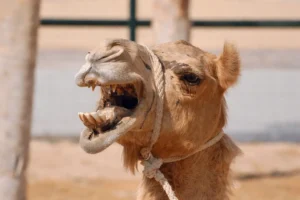
In the 1850s, the American Southwest was a logistical nightmare for the U.S. Army. The terrain was too brutal for horses, too dry for mules, and too vast for the infantry. Seeking a solution, Secretary of War (and future Confederate President) Jefferson Davis looked to the Middle East.
His solution was the U.S. Camel Corps. It was a scientifically sound plan that ended in a feral disaster, leaving a trail of “monster” sightings and ghost stories that would haunt the frontier for nearly a century.
1. The Logistics: Why Camels?

In 1855, the Army sent the USS Supply to the Mediterranean to acquire 33 camels. The reasoning was flawless on paper:
- Endurance: A camel could carry 600 pounds for 30 miles a day without water.
- Diet: They ate the scrub and cacti that horses and mules refused to touch.
- Navigation: They were biologically designed for the exact environment the Army was trying to conquer.
2. The Culture Clash: Mules vs. Dromedaries

The experiment hit a wall immediately, not because of the camels, but because of the soldiers. U.S. troops hated them.
- The Smell: The pungent odor of the camels was said to be so strong it would cause horses and mules to stampede in terror.
- The Temperament: Unlike horses, camels don’t aim to please. When mistreated or overworked, they spit, bite, and simply sit down.
- The Learning Curve: American soldiers had no idea how to pack a camel saddle or manage their unique gait. The Army had to hire “Hi Jolly” (Hadji Ali), a Greek-Syrian lead camel driver, just to keep the Corps moving.
3. The Great Escape: Civil War Chaos

The Camel Corps was headquartered at Camp Verde, Texas. When the Civil War broke out in 1861, the camp was seized by Confederate forces. In the confusion of the takeover and the subsequent lack of interest from the Rebel government, dozens of camels were simply turned loose or wandered off.
These camels didn’t die out immediately. Many turned feral, reproduced modestly, and roamed arid Southwest regions like Texas, Arizona, New Mexico, and California for decades. Sightings persisted into the 1940s, though they never formed large populations or spread to distant areas like Utah’s salt flats or British Columbia.
4. The Legend of the “Red Ghost”

Because most pioneers had never seen a camel, sightings of these “humped monsters” fueled terrifying urban legends. The most famous was the Red Ghost of Arizona.
In the 1880s, ranchers reported a massive, reddish beast trampling gardens and even killing a woman. The legend grew to include a “ghostly rider” strapped to the animal’s back. When the animal was finally shot years later, it turned out to be a real Camel Corps veteran. Twisted into its hide were pieces of leather rawhide—and the skeletal remains of a human being who had been lashed to the saddle and left to die.
5. The End of the Line

The last of the original Army camels, “Topsy,” died in a Los Angeles zoo in 1934. However, sightings of feral offspring in the wild were reported as late as 1941.
While the Camel Corps is often remembered as a military punchline, modern historians point out that the experiment was technically a success. The camels outperformed the horses in every desert trial—they just couldn’t overcome the prejudice of the men tasked with riding them.